

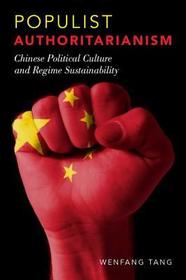
Populist Authoritarianism
Chinese Political Culture and Regime Sustainability
- Publisher's listprice GBP 42.99
-
19 409 Ft (18 485 Ft + 5% VAT)
The price is estimated because at the time of ordering we do not know what conversion rates will apply to HUF / product currency when the book arrives. In case HUF is weaker, the price increases slightly, in case HUF is stronger, the price goes lower slightly.
- Discount 10% (cc. 1 941 Ft off)
- Discounted price 17 468 Ft (16 637 Ft + 5% VAT)
Subcribe now and take benefit of a favourable price.
Subscribe
19 409 Ft

Availability
printed on demand
Why don't you give exact delivery time?
Delivery time is estimated on our previous experiences. We give estimations only, because we order from outside Hungary, and the delivery time mainly depends on how quickly the publisher supplies the book. Faster or slower deliveries both happen, but we do our best to supply as quickly as possible.
Product details:
- Publisher OUP USA
- Date of Publication 18 February 2016
- ISBN 9780190205799
- Binding Paperback
- No. of pages240 pages
- Size 234x155x15 mm
- Weight 340 g
- Language English 0
Categories
Short description:
Populist Authoritarianism attempts to explain why protests and regime support coexist in China. It proposes a theoretical framework of Populist Authoritarianism as the explanation of regime sustainability. The book draws empirical evidence from multiple public opinion surveys conducted from 1987 to 2014.
MoreLong description:
Populist Authoritarianism focuses on the Chinese Communist Party, which governs the world's largest population in a single-party authoritarian state. Wenfang Tang attempts to explain the seemingly contradictory trends of the increasing number of protests on the one hand, and the results of public opinion surveys that consistently show strong government support on the other hand. The book points to the continuity from the CCP's revolutionary experiences to its current governing style, even though China has changed in many ways on the surface in the post-Mao era. The book proposes a theoretical framework of Populist Authoritarianism with six key elements, including the Mass Line ideology, accumulation of social capital, public political activism and contentious politics, a government that is responsive to hype, weak political and civil institutions, and a high level of regime trust. These traits of Populist Authoritarianism are supported by empirical evidence drawn from multiple public opinion surveys conducted from 1987 to 2014. Although the CCP currently enjoys strong public support, such a system is inherently vulnerable due to its institutional deficiency. Public opinion can swing violently due to policy failure and the up and down of a leader or an elite faction. The drastic change of public opinion cannot be filtered through political institutions such as elections and the rule of law, creating system-wide political earthquakes.
Wenfanf Tang's book is an important and illuminating read for both students of China and students of authoritarianism more generally.
Table of Contents:
Chapter 1 CHINESE POLITICAL CULTURE AND REGIME SUSTAINABILITY
Introduction
Why Does Political Culture Matter?
Mass Line: the Origin of the Populist Authoritarian Political Culture
Primitive Accumulation of Social Capital in China
Political Culture in Post-Mao China
The Plan of the Book
Political support: local vs. center
Regime stability and national identity
Social capital
Political trust in China and Taiwan
Protest and regime sustainability
Labor dispute resolution
Political trust: an experimental study
Populist Authoritarianism: A Theoretical Discussion
Using Survey Data to Study Political Change in China
Chapter 2 AUTHORITARIAN REGIME SUSTAINABILITY
The Coming Collapse of China: How Soon?
Modernization and democracy
Regime crisis
Regime durability
Horizontal vs. vertical supports
How Satisfied and Happy Are the Chinese?
Government Dissatisfaction and Life Dissatisfaction
Public Anger, Political Action and Democratic Change
Conclusions
Chapter 3 NATIONALISM AND REGIME SUSTAINABILITY
Theories of Nationalism
Nationalism in China
Sources of Chinese Nationalism
The Political Consequences of Chinese Nationalism
Conclusions
Chapter 4 INTERPERSONAL TRUST AND REGIME SUSTAINABILITY
The Puzzle
Interpersonal Trust and Democracy
Origins of Interpersonal Trust
Confucian Tradition
Socialist Legacy
Economic Growth and Marketization
Findings I: Classification of Interpersonal Trust
Three Types of Interpersonal Trust
Three Types of Trust and General Interpersonal Trust
Findings II Trust and Political Attitudes and Behavior
Conclusions
Chapter 5 POLITICAL TRUST IN CHINA AND TAIWAN
What is political trust?
Competing theories of political trust
Political mobilization
Economic satisfaction
Internal efficacy
External efficacy
Culture
Comparing China and Taiwan: Methods and Data
Measuring and comparing political trust in China and Taiwan
Measuring and comparing the sources of political trust in China and Taiwan
Multivariate analysis of political trust in China and Taiwan
Conclusion and discussion
Chapter 6 REGIME INSPIRED CONTENTIOUS POLITICS
The Rise of Contentious Politics in China
The Contentious Politics Literature
Regime-Mobilized Contentious Politics in China
Institutional Deficiencies and Populist Authoritarianism
Examples of Regime Mobilized Contentious Politics
Case Studies and Large-N Analysis
The Scope of Collective Action
Group Leaders
Regional Distribution
Multivariate Analysis
Central and local governments
Targets of group action
Unfair treatment
Age
Education
Gender
Urbanization and ethnicity
Conclusions and Discussion
Chapter 7 INDIVIDUAL DISPUTE RESOLUTION
Scope and Type of Disputes
Channels of Dispute Settlement
Established official channels
Emerging institutional channels
Non-institutional channels
Hypothetical and actual channels
Socio-economic characteristics of dispute resolution
Economic Organizations and the Politics of Dispute Resolution
Conclusion and discussion
Chapter 8 POLITICAL TRUST: AN EXPERIMENTAL STUDY
List experiment
Data and methodology
Findings
Robustness Check
Conclusions and Discussion
Chapter 9 POPULIST AUTHORITARIANISM: A PRELIMINARY THEORETICAL DISCUSSION
Key components of the PA Model
The Continuity of the Mass Line Ideology
Social Capital and Interpersonal Trust
Political Contention and Participation
Weak Institutions
The Hyper Responsive Government
Strong Political Support
The PA Model and Civic Culture
The PA Model and the BA State
The PA Model and the Existing Studies of Mass Politics
The PA Model and the Study of Comparative Politics

