

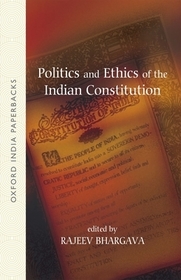
Politics and Ethics of the Indian Constitution
Series: Oxford India Paperbacks;
- Publisher's listprice GBP 14.99
-
6 767 Ft (6 445 Ft + 5% VAT)
The price is estimated because at the time of ordering we do not know what conversion rates will apply to HUF / product currency when the book arrives. In case HUF is weaker, the price increases slightly, in case HUF is stronger, the price goes lower slightly.
- Discount 10% (cc. 676 Ft off)
- Discounted price 6 091 Ft (5 801 Ft + 5% VAT)
Subcribe now and take benefit of a favourable price.
Subscribe
6 767 Ft

Availability
Only to order.
Why don't you give exact delivery time?
Delivery time is estimated on our previous experiences. We give estimations only, because we order from outside Hungary, and the delivery time mainly depends on how quickly the publisher supplies the book. Faster or slower deliveries both happen, but we do our best to supply as quickly as possible.
Product details:
- Publisher OUP India
- Date of Publication 3 September 2009
- ISBN 9780198063551
- Binding Paperback
- No. of pages418 pages
- Size 215x140x22 mm
- Weight 410 g
- Language English 0
Categories
Short description:
This volume examines various aspects of the Indian Constitution from the perspective of political theory. The essays view the Constitution as a political or ethical document, thereby reflecting configurations of power and interests or articulating a moral vision.
MoreLong description:
This collection of essays analyses the Indian Constitution as a political or an ethical document, from a political theory perspective, reflecting configurations of power and interest or articulating a moral vision. This study of the Constitution provides a platform on which extensive political deliberations and arguments over procedural and substantive issues relating to Indian society can take place. The essays discuss ideas of equality, freedom, citizenship and property, minority rights, democracy and welfare as found in the Constitution. It also asks questions like: Does the Constitution recognize all moral rights possessed by the citizens? What importance does the Constitution accord to the rights that it recognizes? Is the section on duties consistent with the section on fundamental rights? If so, then why do tensions between rights and duties still exist? Is it because the Constitution prescribes duties over rights? Does the Constitution support liberty, equality, and fraternity in equal measure?
The contributors critically examine the potential, achievements, and limitations of the Indian Constitution. They further emphasize the need to examine whether or not a serious disjunction exists between the ideals as enshrined in the Constitution and their expression. The volume also aims to resuscitate political theory in India, evolve a form of political theory that is suitable in the Indian context, and to simultaneously open up Western political theory as it exists today.
Table of Contents:
Acknowledgements; Introduction: Outline of a Political Theory of the Indian Constitution (Rajeev Bhargava);
SECTION I;
The Constitution as a Statement of Indian Identity (Bhikhu Parekh);
Gandhi and the Constitution: Parliamentary Swaraj and Village Swaraj (Thomas Pantham);
Institutional Visions and Sociological Imaginations: The Debate on Panchayati Raj (Peter Ronald deSouza);
Outline of a 'Theory of Practice' of Indian Constitutionalism (Upendra Baxi);
A Text Without Author: Locating the Constituent Assembly as an Event (Aditya Nigam); SECTION II;
The Indian State: Constitution and Beyond (Suhas Palshikar);
Citizenship and the Indian Constitution (Valerian Rodrigues);
Citizenship and the Passive Revolution: Interpreting the First Amendment (Nivedita Menon);
Democracy and Constitutionalism (Sanjay Palshikar);
Constitutional Justice: Positional and Cultural (Gopal Guru);
SECTION III;
Containing the Lower Castes: The Constitutent Assembly and the Reservation Policy (Christophe Jaffrelot);
Affirmative Action for Disadvantaged Groups: A Cross-constitutional Study of India and the US (Ashok Acharya); SECTION IV;
Religion and the Indian Constitution: Questions of Separation and Equality (Gurpreet Mahajan);
Passion and Constraint: Courts and the Regulation of Religious Meaning (Pratap Bhanu Mehta);
Rights versus Representation: Defending Minority Interests in the Constituent Assembly (Shefali Jha);
Minority Representation and the Making of the Indian Constitution (Rochana Bajpai);
Notes on Contributors; Index

