

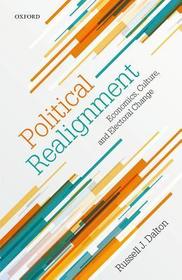
Political Realignment
Economics, Culture, and Electoral Change
- Publisher's listprice GBP 49.99
-
23 882 Ft (22 745 Ft + 5% VAT)
The price is estimated because at the time of ordering we do not know what conversion rates will apply to HUF / product currency when the book arrives. In case HUF is weaker, the price increases slightly, in case HUF is stronger, the price goes lower slightly.
- Discount 10% (cc. 2 388 Ft off)
- Discounted price 21 494 Ft (20 471 Ft + 5% VAT)
Subcribe now and take benefit of a favourable price.
Subscribe
23 882 Ft

Availability
printed on demand
Why don't you give exact delivery time?
Delivery time is estimated on our previous experiences. We give estimations only, because we order from outside Hungary, and the delivery time mainly depends on how quickly the publisher supplies the book. Faster or slower deliveries both happen, but we do our best to supply as quickly as possible.
Product details:
- Publisher OUP Oxford
- Date of Publication 31 October 2018
- ISBN 9780198830986
- Binding Hardback
- No. of pages286 pages
- Size 236x163x20 mm
- Weight 564 g
- Language English 0
Categories
Short description:
This volume examines how social modernization has changed the framework of political competition for citizens and political parties in affluent democracies, and discusses the electoral and political implications of these trends.
MoreLong description:
The process of electoral change is accelerating in contemporary democracies, and this book explains why. The emergence of Green parties in the 1980s and recent far right parties, Brexit and Trump's 2016 victory are parts of this overall process.
Political Realignment tracks the evolution of citizen and elite opinions on economic and cultural issues from the 1970s to the 2010s-and the impact of these changes on electoral politics and public policy. Citizen positions on these cleavages have realigned over time, producing a similar realignment in the structure of the party systems to represent these demands. Economic issues remain important, now joined by divisions on cultural issues as a backlash to modernization. Assembling an unprecedented time series of empirical evidence, this study explains the new forces of elector change in both Europe and the United States.
... an extremely innovative approach...brings new perspectives to an important debate in contemporary political science...a fundamental work for anyone wishing to understand the dilemmas faced by democracies in an increasingly complex and pluralized world.
Table of Contents:
Introduction
The Evolution of Political Competition
Social Structure and Political Cleavages
Citizens, Issues, and Political Cleavages
The Social Distribution of Cleavage Positions
Cleavage Patterns across Nations
Elites, Issues, and Political Cleavages
Political Cleavages and Party Alignments
Placing Parties in the Political Space
Voters and Parties
Congruence and Representation
The American Experience
Conclusion
Realignment and Beyond
Appendices
Issue Questions from the European Election Studies
Citizen Issue Structures by Nation
Identifying Party Positions
Party Cleavage Positions
Party Cleavage Polarization Scores
The Complexity of Measurement
Construction of Economic and Cultural Indices in the United States

