

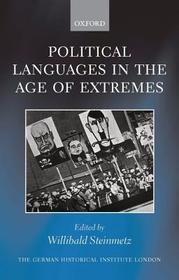
Political Languages in the Age of Extremes
Series: Studies of the German Historical Institute London;
- Publisher's listprice GBP 19.99
-
9 025 Ft (8 595 Ft + 5% VAT)
The price is estimated because at the time of ordering we do not know what conversion rates will apply to HUF / product currency when the book arrives. In case HUF is weaker, the price increases slightly, in case HUF is stronger, the price goes lower slightly.
- Discount 10% (cc. 903 Ft off)
- Discounted price 8 122 Ft (7 736 Ft + 5% VAT)
Subcribe now and take benefit of a favourable price.
Subscribe
9 025 Ft

Availability
Uncertain availability. Please turn to our customer service.
Why don't you give exact delivery time?
Delivery time is estimated on our previous experiences. We give estimations only, because we order from outside Hungary, and the delivery time mainly depends on how quickly the publisher supplies the book. Faster or slower deliveries both happen, but we do our best to supply as quickly as possible.
Product details:
- Publisher Oxford University Press
- Date of Publication 9 November 2012
- ISBN 9780199663330
- Binding Paperback
- No. of pages422 pages
- Size 216x138 mm
- Weight 544 g
- Language English
- Illustrations 7 colour illustrations 0
Categories
Short description:
This volume explores the relationship between language and political power in the Age of Extremes. Topics include leadership cults under Stalin and Mussolini, depictions of enemies, secret diary-writing under Nazism, and the defence strategies of Soviet party members and Gestapo prisoners.
MoreLong description:
The short twentieth century was an age of total wars and aggressive ideological struggles. It was also an age of growing linguistic awareness in the political sphere. Communist, fascist, and Liberal regimes fought each other with violence as well as words, and verbal warfare became increasingly sophisticated. The regimes were supported by propaganda experts and took advantage of new mass media which facilitated the interplay of words, images, and sounds. Leaders and
their propagandists used language to persuade followers, terrorize opponents, and annihilate enemies. Knowing how to adapt one's own use of language to changing political situations was of vital importance for everyone. In the Age of Extremes words could wield political power, but at another moment
even a whisper could endanger one's life.
This volume explores the ways in which language served to create, uphold, subvert, or deflect political power in the Age of Extremes. The book is unusual in encouraging its readers to compare totalitarian and democratic regimes under this aspect. Moving beyond propaganda studies the book opens up a variety of perspectives. While some authors take a look from above and show how those in power succeeded, or failed, in policing the boundaries of what could be said, others investigate the
strategies of those who attacked the rules of the powerful by promoting alternative concepts and counter-discourses. Finally, there are also essays on the experiences of those who simply tried to stay alive by presenting themselves in a flexible manner or preserving their own private languages in diaries,
poems, or secret conversations.

