

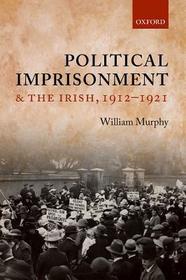
Political Imprisonment and the Irish, 1912-1921
- Publisher's listprice GBP 38.49
-
17 378 Ft (16 550 Ft + 5% VAT)
The price is estimated because at the time of ordering we do not know what conversion rates will apply to HUF / product currency when the book arrives. In case HUF is weaker, the price increases slightly, in case HUF is stronger, the price goes lower slightly.
- Discount 10% (cc. 1 738 Ft off)
- Discounted price 15 640 Ft (14 895 Ft + 5% VAT)
Subcribe now and take benefit of a favourable price.
Subscribe
17 378 Ft

Availability
printed on demand
Why don't you give exact delivery time?
Delivery time is estimated on our previous experiences. We give estimations only, because we order from outside Hungary, and the delivery time mainly depends on how quickly the publisher supplies the book. Faster or slower deliveries both happen, but we do our best to supply as quickly as possible.
Product details:
- Publisher OUP Oxford
- Date of Publication 14 April 2016
- ISBN 9780198784555
- Binding Paperback
- No. of pages314 pages
- Size 234x156x17 mm
- Weight 508 g
- Language English 0
Categories
Short description:
An analysis of the impact of political prisoners during a period when prisons were at the heart of a series of contests in Irish history, including the violent campaign for Irish independence.
MoreLong description:
For a revolutionary generation of Irishmen and Irishwomen - including suffragettes, labour activists, and nationalists - imprisonment became a common experience. In the years 1912-1921, thousands were arrested and held in civil prisons or in internment camps in Ireland and Britain. The state's intent was to repress dissent, but instead, the prisons and camps became a focus of radical challenge to the legitimacy and durability of the state.
Some of these prisons and prisoners are famous: Terence MacSwiney and Thomas Ashe occupy a central position in the prison martyrology of Irish republican culture, and Kilmainham Gaol has become one of the most popular tourist sites in Dublin. In spite of this, a comprehensive history of political imprisonment focused on these years does not exist. In Imprisonment and the Irish, 1912-1921, William Murphy attempts to provide such a history. He seeks to detail what it was like to be a political prisoner; how it smelled, tasted, and felt. More than that, the volume demonstrates that understanding political imprisonment of this period is one of the keys to understanding the Irish revolution.
Murphy argues that the politics of imprisonment and the prison conflicts analysed here reflected and affected the rhythms of the revolution. In doing so, he not only reconstructs and assesses the various experiences and actions of the prisoners, but those of their families, communities, and political movements, as well as the attitudes and reactions of the state and those charged with managing the prisoners.
Political Imprissonment in Ireland marks the appearance of a significant publication relating to Ireland's revolutionary decade. This is the first comprehensive study of political imprisonment in the years 1912 to 1921, when 6,129 men and women were either interned or imprisoned as a result of the unrest in the country in the aftermath of the 1916 rebellion and subsequent War of Independence.
Table of Contents:
Introduction
'What is Good Enough for the Suffragettes': Ireland, 1912-1914
'In Place of an Academy We Have a Jail': Ireland, Summer 1915 - Easter 1916
'Nowhere Else Does One Learn to Know a Colleague So Well': May 1916 - June 1917
'Hunger-Strike Mania': Ireland, June 1917- June 1918
'The Same Walls & Doors & Gates & Persons': Internment (Britain) May 1918 - March 1919
'Out with the Warrants, Set On the G Men, Roll Up the Black Marias, Fill Up the Jails': June 1918 - July 1919
'You Will Find They Will Climb Down': August 1919-June 1920
'The Tower of Hunger': August-November 1920
'Home Rule within the Empire': November 1920 - June 1921
'Every Internee was a Centre of Disaffection': Truce to Treaty
'The Gates are Thrown Open'
Conclusion
Bibliography
Appendices

