

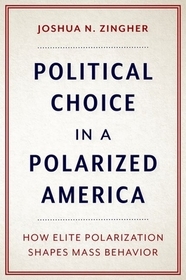
Political Choice in a Polarized America
How Elite Polarization Shapes Mass Behavior
- Publisher's listprice GBP 88.00
-
42 042 Ft (40 040 Ft + 5% VAT)
The price is estimated because at the time of ordering we do not know what conversion rates will apply to HUF / product currency when the book arrives. In case HUF is weaker, the price increases slightly, in case HUF is stronger, the price goes lower slightly.
- Discount 10% (cc. 4 204 Ft off)
- Discounted price 37 838 Ft (36 036 Ft + 5% VAT)
Subcribe now and take benefit of a favourable price.
Subscribe
42 042 Ft

Availability
Estimated delivery time: Expected time of arrival: end of January 2026.
Not in stock at Prospero.
Why don't you give exact delivery time?
Delivery time is estimated on our previous experiences. We give estimations only, because we order from outside Hungary, and the delivery time mainly depends on how quickly the publisher supplies the book. Faster or slower deliveries both happen, but we do our best to supply as quickly as possible.
Product details:
- Publisher OUP USA
- Date of Publication 14 July 2022
- ISBN 9780197630693
- Binding Hardback
- No. of pages250 pages
- Size 159x241x18 mm
- Weight 490 g
- Language English 278
Categories
Short description:
What motivates citizens to support one party over the other? Tackling decades of mixed findings about the prevalence (or lack) of policy voting, Joshua N. Zingher argues that the average American is much more likely to vote for the party that best represents their views than they were in the past. However, as Zingher demonstrates, voters' ability to match their attitudes to a party or candidate varies according to signals sent by elites and increases as parties become more polarized. As a result, American voters have adapted to a more polarized environment by becoming more polarized themselves.
MoreLong description:
What motivates citizens to support one party over the other? Do they carefully weigh all of the relevant issues and assess which party or candidate best matches their own positions? Or do people look at politics as something more akin to a team sport--the specifics do not matter as long as you know what side your team is on? Answering these questions requires us to think about how much the average American knows about politics. Many scholars of public opinion believe that the majority of Americans only pay passing attention to politics. Thus the electorate's apparent lack of political competence presents a direct challenge to normative theories of democracy. How are citizens supposed to exert control over the government if they have no idea what is going on?
In Political Choice in a Polarized America, Joshua N. Zingher argues that these fears are overblown. Not only do individuals have core beliefs about what the government should or should not do, but individuals have become more likely to support the party that best matches their policy attitudes by both identifying as a member of that party and voting for that party in elections. However, as Zingher demonstrates, voters' ability to match their attitudes to a party or candidate varies according to signals sent by elites and increases as parties become more polarized. This is true even among citizens with less political knowledge and efficacy. Voters now consistently cast ballots for the candidates who best match their own policy orientations and are increasingly likely to express hostility towards members of the other party due to growing elite polarization. Moreover, policy preferences tend to remain stable over time and both shape and are shaped by partisanship. Tackling decades of mixed findings about the prevalence (or lack) of policy voting, Zingher argues that the average American is much more likely to vote for the party that best represents their views than they were in the past. American voters have adapted to a more polarized environment by becoming more polarized themselves.
Joshua Zingher's Political Choice in a Polarized America provides a fresh perspective on the central development in American electoral politics of the past half century-the rise of mass ideological polarization. Zingher demonstrates that ordinary citizens' policy preferences are increasingly organized into coherent belief systems and play a central role in shaping partisan attachments and voting decisions. This book is must reading for both scholars and concerned citizens who want to understand American elections and voting behavior in the current era of deep partisan polarization.
Table of Contents:
Dedication
Acknowledgements
Chapter 1: America the Polarized
Chapter 2: Mass Opinion in Context: How Elite Polarization Shapes Political Behavior
Chapter 3: Elite Polarization and Americans' Perceptions of the Political Parties
Chapter 4: Measuring Policy Orientations and Political Sophistication
Chapter 5: A Test of the Recursive Relationship Between Policy Orientations and Partisanship
Chapter 6: The Relationships Between Policy Orientations, Partisanship, and Vote Choice
Chapter 7: A Test of How Elite Polarization Shapes Mass Political Behavior
Chapter 8: How Political Sophistication Shapes Responses to Elite Polarization
Chapter 9: The Implications of Our Polarized Politics
References
Index

