

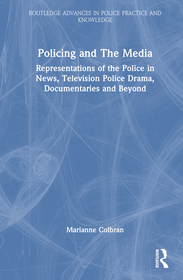
Policing and The Media
Representations of the Police in News, Television Police Drama, Documentaries and Beyond
Series: Routledge Advances in Police Practice and Knowledge;
-
GET 10% OFF
- Publisher's listprice GBP 155.00
-
74 051 Ft (70 525 Ft + 5% VAT)
The price is estimated because at the time of ordering we do not know what conversion rates will apply to HUF / product currency when the book arrives. In case HUF is weaker, the price increases slightly, in case HUF is stronger, the price goes lower slightly.
- Discount 10% (cc. 7 405 Ft off)
- Discounted price 66 646 Ft (63 473 Ft + 5% VAT)
66 646 Ft

Availability
Not yet published.
Why don't you give exact delivery time?
Delivery time is estimated on our previous experiences. We give estimations only, because we order from outside Hungary, and the delivery time mainly depends on how quickly the publisher supplies the book. Faster or slower deliveries both happen, but we do our best to supply as quickly as possible.
Product details:
- Edition number 1
- Publisher Routledge
- Date of Publication 22 April 2026
- ISBN 9781032235363
- Binding Hardback
- No. of pages192 pages
- Size 234x156 mm
- Weight 453 g
- Language English 700
Categories
Short description:
This important new book looks for the first time at the stories the media tell about the police. It looks at the way in which the police have been represented historically across a variety of media. It breaks new ground by exploring the process and how a variety of factors, including police/media relations, shape these narratives.
MoreLong description:
What do you think of when you think of the police? Bobbies on the beat? Or perhaps bleaker images of police brutality such as the murder of George Floyd by a serving police officer?
For most people, the media are the main source of information about the police. For that reason, being represented positively in the media is an abiding concern for the police.
This important new book looks for the first time at the stories the media tell about the police. It looks at the way in which the police have been represented historically across a variety of media, including crime news, police dramas, documentaries, social media, and podcasts. But it also breaks new ground by exploring the process as well as the product and how a variety of factors, including police/media relations, shape these narratives.
Some of the key themes explored are:
• Impact of new digital technologies in reconfiguring relations between the police, the press, and the public
• Critical examination of “the thin blue line” narrative
• The problems of the maverick cop trope
• Increasing police control over crime information
• The stigmatisation of certain communities – in particular, Black, Brown, LGBTQ+ , and Gypsy, Roma, and Traveller citizens – particularly in crime news and reality shows
• Examining whose stories remain untold in popular representations
• Ramifications of these themes for public understanding
The book will be of key interest to Professional Policing students and researchers, as well as police professionals. It will also be essential reading for students and scholars of criminology, media studies, and cultural studies, as well as for all those interested in these intersections.
The media and the police have had a codependent relationship since they emerged in their modern forms over two centuries ago. Both serve crucial functions for each other, but they have often been in conflict. This excellent book reviews and analyses this tense but unending relationship between two pivotal powerful institutions. It charts and explains the amity and discord as it has fluctuated over time, and is comprehensive and up to date. Written by an eminent authority who has done much original research especially on processes of media production, it is a must read for all students, practitioners and policymakers concerned with policing. Composed in a clear, engaging style it will also fascinate general readers who have always provided large audiences for police stories in many formats.
Robert Reiner, Emeritus Professor of Criminology, LSE Law School
Colbran provides incisive analysis on media representations of policing amid growing awareness through media fragmentation that police do not treat everybody the same. Colbran emphasises that because many people will base their perceptions of the police on their media consumption, that every selection of a news media angle on police and policing involves omissions that never make into the news media or social media frame. Through a range of insightful case studies from the UK, the US, and Australia, she puts media production processes into the frame. As she rightly notes, without critically analysing how, why and what makes it into the final media products that represent policing, we will continue to gloss the structural inequities that can be perpetuated through stereotypical interpretations of policing in digital societies.
Justin Ellis, Senior Lecturer in Criminology, University of Newcastle, Australia
This timely text offers a critical examination of the evolving relationship between police and the media at a moment when questions of representation, trust, and legitimacy are more pressing than ever. Drawing on her distinctive perspective as a former television writer, her empirical research into police-media relations, and her engagement with a wide body of international scholarship, Colbran expertly explores how police narratives are constructed across news, entertainment, and social media, and why these stories matter. Rich with case studies and examples, grounded in key conceptual frameworks, and featuring reflective questions at the end of each chapter, this book is an invaluable resource for students and scholars seeking an introduction the complex interplay between the police, media, and public perceptions.
Alyce Mc Govern, Associate Professor in Criminology, University of New South Wales. Australia.
Colbran has produced an extensive exacting overview of the relationship between police, media and ultimately the public. Importantly, it explores submerged narratives and hidden agendas, exposing media simplification and exaggeration, as well plotting the extent that police will go to in furthering agendas. In a period where trust in police has waned, and police scandals are semi-regular news, Colbran’s exploration of police media power seems particularly pertinent. The book should be of immense value to students and scholars of policing studies and criminology.
Murray Lee, Professor of Criminology, University of Sydney.
MoreTable of Contents:
1. Police and the media: setting the scene 2. How representations of the police in the news have changed over the last fifty years 3. Creating news stories: the impact of police and media relations on crime news 4. Policing and social media 5. Thief-takers and rule-breakers: the changing image of the TV cop 6. Why television police dramas never tell the "truth" about policing 7. The police and “reality” television 8. The "thin blue line" and other themes: the problems with media representations of policing
More
