

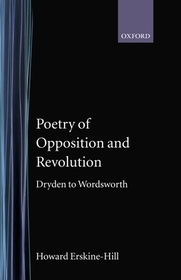
Poetry of Opposition and Revolution
Dryden to Wordsworth
- Publisher's listprice GBP 70.00
-
31 605 Ft (30 100 Ft + 5% VAT)
The price is estimated because at the time of ordering we do not know what conversion rates will apply to HUF / product currency when the book arrives. In case HUF is weaker, the price increases slightly, in case HUF is stronger, the price goes lower slightly.
- Discount 10% (cc. 3 161 Ft off)
- Discounted price 28 445 Ft (27 090 Ft + 5% VAT)
Subcribe now and take benefit of a favourable price.
Subscribe
31 605 Ft

Availability
printed on demand
Why don't you give exact delivery time?
Delivery time is estimated on our previous experiences. We give estimations only, because we order from outside Hungary, and the delivery time mainly depends on how quickly the publisher supplies the book. Faster or slower deliveries both happen, but we do our best to supply as quickly as possible.
Product details:
- Publisher Clarendon Press
- Date of Publication 4 July 1996
- ISBN 9780198121770
- Binding Hardback
- No. of pages284 pages
- Size 225x146x20 mm
- Weight 522 g
- Language English
- Illustrations frontispiece, 6 halftones 0
Categories
Short description:
This is a major study of the relation between poetry and politics from the 1688 Revolution to the early years of the nineteenth century, focusing in particular on the works of Dryden, Pope, Johnson, and Wordsworth. Building on his argument in Poetry and the Realm of Politics: Shakespeare to Dryden (also available from OUP), Howard Erskine-Hill argues that the major tradition of political allusion is not, as has often been argued, that of political allegory and overtly political poems, but rather a more shifting and less systematic practice, often involving equivocal or multiple reference.
MoreLong description:
Poetry of Opposition and Revolution is an important new study of the relation between poetry and politics in English literature from Dryden to Wordsworth. Building on his argument in Poetry and the Realm of Politics: Shakespeare to Dryden (also available from OUP), Howard Erskine-Hill reveals that the major tradition of political allusion is not, as has often been argued, that of the political allegory and overtly political poems, but rather a more shifting and less systematic practice, often involving equivocal or multiple reference. Drawing on the revisionist trend in recent historiography, the book offers new and thought-provoking readings of familiar texts. Dryden's Aeneid version and Pope's Rape of The Lock are shown to belong not just to contemporary convention, but to a more widespread and older style of envisioning high politics and the crises of government. The early books of The Prelude can be seen to show marked political features; reflections of the 1688 Revolution are traced in The Rape of the Lock; and a Jacobite emotion is identified in The Vanity of Human Wishes. Taking issue with recent New Historicist Romantic criticism, the concluding chapters argue that what have seemed to many to be traces of covert political displacement or erasure in Wordsworth are in fact marks of a continuing political preoccupation, which found new forms after the collapse of the Enlightenment programme into the Jacobin terror.
One of the many virtues of Howard Erskine-Hill's Poetry and Revolution (the sequel to his Poetry and the Realm of Politics) is the care with which it reconstructs these climates of interpretation

