

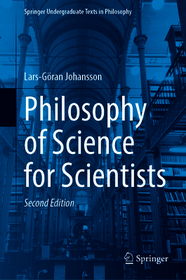
Philosophy of Science for Scientists
Series: Springer Undergraduate Texts in Philosophy;
- Publisher's listprice EUR 80.24
-
31 341 Ft (29 849 Ft + 5% VAT)
The price is estimated because at the time of ordering we do not know what conversion rates will apply to HUF / product currency when the book arrives. In case HUF is weaker, the price increases slightly, in case HUF is stronger, the price goes lower slightly.
- Discount 12% (cc. 3 761 Ft off)
- Discounted price 27 580 Ft (26 267 Ft + 5% VAT)
Subcribe now and take benefit of a favourable price.
Subscribe
27 580 Ft

Availability
Not yet published.
Why don't you give exact delivery time?
Delivery time is estimated on our previous experiences. We give estimations only, because we order from outside Hungary, and the delivery time mainly depends on how quickly the publisher supplies the book. Faster or slower deliveries both happen, but we do our best to supply as quickly as possible.
Product details:
- Edition number 2
- Publisher Springer Nature Switzerland
- Date of Publication 20 August 2026
- ISBN 9783032298683
- Binding Hardback
- No. of pages274 pages
- Size 235x155 mm
- Language English
- Illustrations XVII, 274 p. 18 illus. 700
Categories
Long description:
This second edition of the successful textbook Philosophy of Science for Scientists offers an introduction to the philosophy of science. This new edition contains updated references and expanded discussions on seven important topics: knowledge, use of statistics in hypothesis testing, hermeneutics, causation, explanations of actions, models, and mental causation. It helps undergraduate students from the natural, the human and social sciences to gain an understanding of what science is, how it has developed, what its core traits are, how to distinguish between science and pseudo-science and to discover what a scientific attitude is. It argues against the common assumption that there is fundamental difference between natural and human science, with natural science being concerned with testing hypotheses and discovering natural laws, and the aim of human and some social sciences being to understand the meanings of individual and social group actions. Instead examines the similarities between the sciences and shows how the testing of hypotheses and doing interpretation/hermeneutics are similar activities. The book makes clear that lessons from natural scientists are relevant to students and scholars within the social and human sciences, and vice versa. It teaches its readers how to effectively demarcate between science and pseudo-science and sets criteria for true scientific thinking.
MoreTable of Contents:
Part I: What is Science?.- 1 The Evolution of Science.- 2 Knowledge.- 3 Hypotheses and Hypothesis Testing.- 4 On Scientific Data.- 5 Qualitative Data and Methods.- 6 Theories about the Development of Science.- Part II: Philosophical Reflections on Four Core concenpts in Science: Causes, Explanations, Laws and Models.- 7 On Causes and Correlations.- 8 Explanations.- 9 Explanation in the Humanities and Social Sciences.- 10 Scientific Laws.- 11 Theories, Models and Reality.- Part III: Some Auxiliaries.- 12 The Mind-Body Problem.- 13 Science and Values.- 14 Some Recent Trends in Science.- Appendix - Logical Forms.- Definitions of Some Core Concepts.- Answers to Exercises in Chapters 3, 7, 8, and 9.- Index.- Literature.
More
