

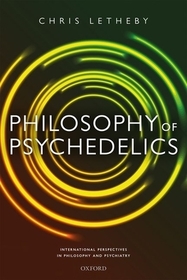
Philosophy of Psychedelics
Series: International Perspectives in Philosophy and Psychiatry;
- Publisher's listprice GBP 30.49
-
13 766 Ft (13 110 Ft + 5% VAT)
The price is estimated because at the time of ordering we do not know what conversion rates will apply to HUF / product currency when the book arrives. In case HUF is weaker, the price increases slightly, in case HUF is stronger, the price goes lower slightly.
- Discount 10% (cc. 1 377 Ft off)
- Discounted price 12 389 Ft (11 799 Ft + 5% VAT)
Subcribe now and take benefit of a favourable price.
Subscribe
13 766 Ft

Availability
printed on demand
Why don't you give exact delivery time?
Delivery time is estimated on our previous experiences. We give estimations only, because we order from outside Hungary, and the delivery time mainly depends on how quickly the publisher supplies the book. Faster or slower deliveries both happen, but we do our best to supply as quickly as possible.
Product details:
- Publisher OUP Oxford
- Date of Publication 5 August 2021
- ISBN 9780198843122
- Binding Hardback
- No. of pages272 pages
- Size 241x163x19 mm
- Weight 550 g
- Language English 126
Categories
Short description:
This book is the first scholarly monograph in English devoted to the philosophical analysis of psychedelic drugs. Its central focus is the apparent conflict between the growing use of psychedelics in psychiatry and the philosophical worldview of naturalism.
MoreLong description:
Recent clinical trials show that psychedelics such as LSD and psilocybin can be given safely in controlled conditions, and can cause lasting psychological benefits with one or two administrations. Supervised psychedelic sessions can reduce symptoms of anxiety, depression, and addiction, and improve well-being in healthy volunteers, for months or even years. But these benefits seem to be mediated by "mystical" experiences of cosmic consciousness, which prompts a philosophical concern: do psychedelics cause psychological benefits by inducing false or implausible beliefs about the metaphysical nature of reality?
This book is the first scholarly monograph in English devoted to the philosophical analysis of psychedelic drugs. Its central focus is the apparent conflict between the growing use of psychedelics in psychiatry and the philosophical worldview of naturalism.
Within the book, Letheby integrates empirical evidence and philosophical considerations in the service of a simple conclusion: this "Comforting Delusion Objection" to psychedelic therapy fails. While exotic metaphysical ideas do sometimes come up, they are not, on closer inspection, the central driver of change in psychedelic therapy. Psychedelics lead to lasting benefits by altering the sense of self, and changing how people relate to their own minds and lives-not by changing their beliefs about the ultimate nature of reality. The upshot is that a traditional conception of psychedelics as agents of insight and spirituality can be reconciled with naturalism (the philosophical position that the natural world is all there is). Controlled psychedelic use can lead to genuine forms of knowledge gain and spiritual growth-even if no Cosmic Consciousness or transcendent divine Reality exists.
Philosophy of Psychedelics is an indispensable guide to the literature for researchers already engaged in the field of psychedelic psychiatry, and for researchers-especially philosophers-who want to become acquainted with this increasingly topical field.
Clearly written, with an accessible overview of a wealth of recent studies, and while it explicitly undertakes to naturalise the "mystical" elements of psychedelic usage, it is nevertheless refreshing to see the phenomenological data taken seriously. There is much thought provoking material here for those interested in taking a more conventional journey through the doors of perception.
Table of Contents:
Introduction
Introduction
On the need for a natural philosophy of psychedelics
Introduction
The psychedelic renaissance
Evidence for safety and efficacy
An existential medicine?
The Comforting Delusion Objection
Naturalizing the entheogenic conception
The phenomenology of psychedelic therapy
Introduction
Perception
The sense of self
The transformative process
Conclusion
The mechanisms of psychedelic therapy
Introduction
Neuroplasticity theories
The Metaphysical Belief Theory
The Metaphysical Alief Theory
Conclusion
The role of self-representation
Introduction
Psychological factors
Neural correlates
Neurocognitive explanation
Conclusion
Resetting the brain
Introduction
The Reset Theory
Predictive processing
Relaxed beliefs under psychedelics
Resetting beliefs under psychedelics
Unbinding the self
Introduction
Predictive self-binding
Selfhood embodied and (temporally) extended
A centre of representational gravity
The self unbound
Opacity and mystical epiphanies
Psychedelic therapy: a two-factor theory
Self and self-consciousness
Conclusion
Epistemology
Introduction
Psychopharmacology and epistemology
Knowledge that
Knowledge how
Knowledge by acquaintance
New knowledge of old facts
Indirect epistemic benefits
Epistemic innocence
Spirituality
Introduction
Naturalizing spirituality
Spirituality as unselfing
Conclusion
Testable predictions
Future directions
Naturalistic entheogenics

