

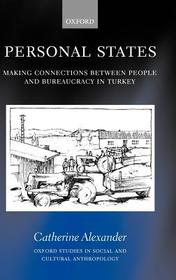
Personal States
Making Connections between People and Bureaucracy in Turkey
Series: Oxford Studies in Social and Cultural Anthropology;
- Publisher's listprice GBP 200.00
-
90 300 Ft (86 000 Ft + 5% VAT)
The price is estimated because at the time of ordering we do not know what conversion rates will apply to HUF / product currency when the book arrives. In case HUF is weaker, the price increases slightly, in case HUF is stronger, the price goes lower slightly.
- Discount 10% (cc. 9 030 Ft off)
- Discounted price 81 270 Ft (77 400 Ft + 5% VAT)
Subcribe now and take benefit of a favourable price.
Subscribe
90 300 Ft

Availability
printed on demand
Why don't you give exact delivery time?
Delivery time is estimated on our previous experiences. We give estimations only, because we order from outside Hungary, and the delivery time mainly depends on how quickly the publisher supplies the book. Faster or slower deliveries both happen, but we do our best to supply as quickly as possible.
Product details:
- Publisher OUP Oxford
- Date of Publication 4 July 2002
- ISBN 9780199251797
- Binding Hardback
- No. of pages284 pages
- Size 242x163x20 mm
- Weight 553 g
- Language English
- Illustrations 14 figures, 7 tables 0
Categories
Short description:
Charting how Turkish people - both within and outside the state bureaucracy - attempt to personalise the impersonality of the state, this elegant, nuanced ethnography will cause scholars of state institutions across a broad range of disciplines radically to rethink what the entity called 'the state' actually is, the relations that create it, and to acknowledge its materiality, thus taking understandings of the state to an entirely new level.
MoreLong description:
Catherine Alexander charts how Turkish people, both within and outside the state bureaucracy, attempt to personalise the impersonality of the state. Based on a detailed study of the nationalized Turkish Sugar Corporation, she considers how people from the highest levels of the state bureaucracy to farming villages understand 'the state', and how, in turn, they imagine themselves to be perceived. The narratives and metaphors used in these constructions draw on resources close to hand such as the material organization of state factory compounds, state personnel encountered in the course of everyday life, and the image of the family structure. By also exploring notions of state and personhood within the highest echelons of the administration itself, Alexander shows how ideas of 'the state' recede once one is actually 'within'. For officials the state becomes other institutions and Ministries with which they have little contact. The continual process of striving to make connections with other groups and people occurs both at all hierarchical levels of the Sugar Corporation and between farmers and factory engineers.
This elegant, nuanced ethnography of modernity will cause scholars of state institutions across a broad range of disciplines radically to rethink what 'the state' actually is, and the relations that create it, thus taking understandings of the state to an entirely new level.

