

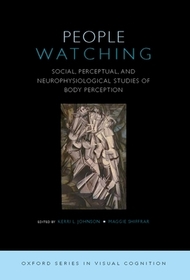
People Watching
Social, Perceptual, and Neurophysiological Studies of Body Perception
Series: Oxford Series in Visual Cognition;
- Publisher's listprice GBP 175.00
-
79 012 Ft (75 250 Ft + 5% VAT)
The price is estimated because at the time of ordering we do not know what conversion rates will apply to HUF / product currency when the book arrives. In case HUF is weaker, the price increases slightly, in case HUF is stronger, the price goes lower slightly.
- Discount 10% (cc. 7 901 Ft off)
- Discounted price 71 111 Ft (67 725 Ft + 5% VAT)
Subcribe now and take benefit of a favourable price.
Subscribe
79 012 Ft

Availability
printed on demand
Why don't you give exact delivery time?
Delivery time is estimated on our previous experiences. We give estimations only, because we order from outside Hungary, and the delivery time mainly depends on how quickly the publisher supplies the book. Faster or slower deliveries both happen, but we do our best to supply as quickly as possible.
Product details:
- Publisher OUP USA
- Date of Publication 10 January 2013
- ISBN 9780195393705
- Binding Hardback
- No. of pages438 pages
- Size 188x257x35 mm
- Weight 953 g
- Language English 0
Categories
Short description:
The scientific study of the human body has burgeoned in recent years, and scholars from wide-ranging disciplines are now seeking to understand just how much information can be conveyed by the human body in motion. This volume sheds light on the potency of the human body to inform our most basic perceptions of one another.
MoreLong description:
The human body has long been a rich source of inspiration for the arts, and artists have long recognized the body's special status. While the scientific study of body perception also has an important history, recent technological advances have triggered an explosion of research on the visual perception of the human body in motion, or as it is traditionally called, biological motion perception. Now reaching a point of burgeoning inter-disciplinary focus, biological motion perception research is poised to transform our understanding of person construal. Indeed, several factors highlight a privileged role for the human body as one of the most critical classes of stimuli affecting social perception. Human bodies in motion, for example, are among the most frequent moving stimulus in our environment. They can be readily perceived at a physical distance or visual vantage that precludes face perception. Moreover, body motion conveys meaningful psychological information such as social categories, emotion state, intentions, and underlying dispositions. Thus, body perception appears to serve as a first-pass filter for a vast array of social judgments from the routine (e.g., perceived friendliness in interactions) to the grave (e.g., perceived threat by law enforcement). This book provides an exciting integration of theory and findings that clarify how the human body is perceived by observers.
The authors have produced a ground-breaking book that is the absolute go-to resource for anyone interested in learning about the origins and the direction for future research in this area...This is a must-read for graduate students in psychology and communication studies, as well as students who are interested in the visual perception of the human body.
Table of Contents:
I. Introduction
Chapter 1: Making Great Strides: Advances in Research on the Perception of the Human Body
Chapter 2: Gunnar Johansson, Events, and Biological Motion
II. Psychophysics
Chapter 3: Top-Down versus Bottom-up Processing of Biological Motion
Chapter 4: Seeing You through Me: Creating Self-Other Correspondences for Body Perception
Chapter 5: What Does "Biological Motion " Really Mean? Differentiating Visual Percepts of Human, Animal, and Non-biological Motions
Chapter 6: Shape-Independent Processing of Biological Motion
Chapter 7: Action Perception from a Common Coding Perspective
III. Development and Individual Differences
Chapter 8: Developmental Origins of Biological Motion Perception
Chapter 9: Experience and the Perception of Biological Motion
Chapter 10: Variability in the Visual Perception of Human Motion as a Function of the Observer's Autistic Traits
Chapter 11: Development of Body Motion Processing in Normalcy and Pathology
IV. Social Perspectives
Chapter 12: Person (Mis)Perception? On the Biased Representation of the Human Body.
Chapter 13: It's the Way You Walk: Kinematic Specification of Vulnerability to Attack
Chapter 14: Coordinating Social Beings in Motion
Chapter 15: Functionalism Redux: How Adaptive Action Constrains Perception, Simulation, and Evolved Intuitions
V. Neurophysiology
Chapter 16: Neural mechanisms for action observation
Chapter 17: Neural Mechanisms for Biological Motion and Animacy
Chapter 18: The How, When, and Why of Configural Processing in the Perception of Human Movement
Chapter 19: Brain Mechanisms for Social Perception: Moving towards an Understanding of Autism
Chapter 20: From Body Perception to Action Preparation: A Distributed Neural System for Viewing Bodily Expressions of Emotion
Chapter 21: Sensory and Motor Brain Areas Subserving Biological Motion Perception: Neuropsychological and Neuroimaging Studies
Chapter 22: Computational Mechanisms of the Visual Processing of Action Stimuli
Index

