

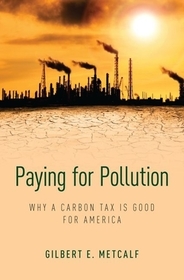
Paying for Pollution
Why a Carbon Tax is Good for America
- Publisher's listprice GBP 40.49
-
18 281 Ft (17 410 Ft + 5% VAT)
The price is estimated because at the time of ordering we do not know what conversion rates will apply to HUF / product currency when the book arrives. In case HUF is weaker, the price increases slightly, in case HUF is stronger, the price goes lower slightly.
- Discount 10% (cc. 1 829 Ft off)
- Discounted price 16 452 Ft (15 669 Ft + 5% VAT)
Subcribe now and take benefit of a favourable price.
Subscribe
18 281 Ft

Availability
printed on demand
Why don't you give exact delivery time?
Delivery time is estimated on our previous experiences. We give estimations only, because we order from outside Hungary, and the delivery time mainly depends on how quickly the publisher supplies the book. Faster or slower deliveries both happen, but we do our best to supply as quickly as possible.
Product details:
- Publisher OUP USA
- Date of Publication 21 February 2019
- ISBN 9780190694197
- Binding Hardback
- No. of pages200 pages
- Size 163x241x20 mm
- Weight 454 g
- Language English 0
Categories
Short description:
Paying for Pollution incisively examines the very real costs-economic and social-of climate change and the challenges of concerted action to reduce future losses due to damages of higher temperatures and more extreme weather. Gilbert E. Metcalf argues that there is a convergence of social, economic, environmental, and political forces that provides an opening for a new approach to climate policy, one based on market principles that can appeal to politicians across the political spectrum. After all, markets work best when the price of a good reflects all its costs.
MoreLong description:
The threats posed by global climate change are widely recognized and carbon emmissions are the major source of greenhouse gases accumulating in the atmosphere. Burning fossil fuels causes long-lasting, pervasive damages, costly to those of us alive today and even more to our children and our children's children. The United States is the second largest carbon emitting country in the world and should play a key role in global efforts to reduce emissions.
Paying for Pollution incisively examines the very real costs-economic and social-of climate change and the challenges of concerted action to reduce future losses due to damages of higher temperatures and more extreme weather. Gilbert E. Metcalf argues that there is a convergence of social, economic, environmental, and political forces that provides an opening for a new approach to climate policy, one based on market principles that can appeal to politicians across the political spectrum. After all, markets work best when the price of a good reflects all its costs.
Metcalf suggests that a thoughtfully and politically sensitive designed carbon tax could also contribute to an improved tax system, something desired by Republican and Democratic politicians alike. That is, a carbon tax increases fiscal flexibility by providing new revenues to finance reforms to the income tax that improve the fairness of the tax code and contribute to economic growth. Metcalf compares the benefits of a carbon tax to other potential policies, such as cap and trade, to reduce the threats of climate change. None, he shows, are as effective, efficient, and fair as a carbon tax.
If economistsran the country, this book would be required readingfor anybody who wanted to understand American climatepolicy.
Table of Contents:
Contents
Introduction
1. Climate Change: What's the Big Deal?
2. Business as Usual: What Are the Costs?
3. Why Do Economists Like a Carbon Tax?
4. Isn't There a Better Way? (No, There Isn't)
5. Cap and Trade: The Other Way to Price Pollution
6. What To Do With $200 Billion: Give It Back
7. So You Want a Carbon Tax: How Do You Design It?
8. Objections to a Carbon Tax
9. Enacting a Carbon Tax: How Do We Get There?
Afterword - What Next?
References
Notes

