

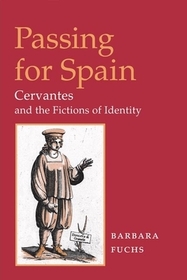
Passing for Spain – CERVANTES and the FICTIONS of IDENTITY
CERVANTES and the FICTIONS of IDENTITY
Series: Hispanisms; 11;
- Publisher's listprice GBP 28.99
-
13 849 Ft (13 190 Ft + 5% VAT)
The price is estimated because at the time of ordering we do not know what conversion rates will apply to HUF / product currency when the book arrives. In case HUF is weaker, the price increases slightly, in case HUF is stronger, the price goes lower slightly.
- Discount 10% (cc. 1 385 Ft off)
- Discounted price 12 465 Ft (11 871 Ft + 5% VAT)
Discounted price for customers subscribed to our weekly newsletter.
Subcribe now and take benefit of a favourable price.
Subscribe
Subcribe now and take benefit of a favourable price.
Subscribe
13 849 Ft

Availability
Estimated delivery time: In stock at the publisher, but not at Prospero's office. Delivery time approx. 3-5 weeks.
Not in stock at Prospero.
Why don't you give exact delivery time?
Delivery time is estimated on our previous experiences. We give estimations only, because we order from outside Hungary, and the delivery time mainly depends on how quickly the publisher supplies the book. Faster or slower deliveries both happen, but we do our best to supply as quickly as possible.
Product details:
- Publisher MO – University of Illinois Press
- Date of Publication 31 December 2002
- Number of Volumes Hardback
- ISBN 9780252027819
- Binding Hardback
- No. of pages160 pages
- Size 229x152x12 mm
- Weight 319 g
- Language English 0
Categories
Long description:
Passing for Spain charts the intersections of identity, nation, and literary representation in early modern Spain. Barbara Fuchs analyzes the trope of passing in Don Quijote and other works by Cervantes, linking the use of disguise to the broader historical and social context of Counter-Reformation Spain and the religious and political dynamics of the Mediterranean Basin.
In five lucid and engaging chapters, Fuchs examines what passes in Cervantes’s fiction: gender and race in Don Quijote and “Las dos doncellas”; religion in “El amante liberal” and La gran sultana; national identity in the Persiles and “La espaÑola inglesa.” She argues that Cervantes represents cross-cultural impersonation -- or characters who pass for another gender, nationality, or religion -- as challenges to the state’s attempts to assign identities and categories to proper Spanish subjects.
Fuchs demonstrates the larger implications of this challenge by bringing a wide range of literary and political texts to bear on Cervantes’s representations. Impeccably researched, Passing for Spain examines how the fluidity of individual identity in early modern Spain undermined a national identity based on exclusion and difference.
More
In five lucid and engaging chapters, Fuchs examines what passes in Cervantes’s fiction: gender and race in Don Quijote and “Las dos doncellas”; religion in “El amante liberal” and La gran sultana; national identity in the Persiles and “La espaÑola inglesa.” She argues that Cervantes represents cross-cultural impersonation -- or characters who pass for another gender, nationality, or religion -- as challenges to the state’s attempts to assign identities and categories to proper Spanish subjects.
Fuchs demonstrates the larger implications of this challenge by bringing a wide range of literary and political texts to bear on Cervantes’s representations. Impeccably researched, Passing for Spain examines how the fluidity of individual identity in early modern Spain undermined a national identity based on exclusion and difference.

