

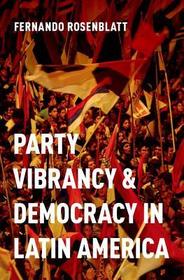
Party Vibrancy and Democracy in Latin America
- Publisher's listprice GBP 94.00
-
44 908 Ft (42 770 Ft + 5% VAT)
The price is estimated because at the time of ordering we do not know what conversion rates will apply to HUF / product currency when the book arrives. In case HUF is weaker, the price increases slightly, in case HUF is stronger, the price goes lower slightly.
- Discount 10% (cc. 4 491 Ft off)
- Discounted price 40 418 Ft (38 493 Ft + 5% VAT)
Subcribe now and take benefit of a favourable price.
Subscribe
44 908 Ft

Availability
printed on demand
Why don't you give exact delivery time?
Delivery time is estimated on our previous experiences. We give estimations only, because we order from outside Hungary, and the delivery time mainly depends on how quickly the publisher supplies the book. Faster or slower deliveries both happen, but we do our best to supply as quickly as possible.
Product details:
- Publisher OUP USA
- Date of Publication 7 June 2018
- ISBN 9780190870041
- Binding Hardback
- No. of pages304 pages
- Size 160x236x30 mm
- Weight 544 g
- Language English
- Illustrations 1 line drawing, 56 boxes, and 3 tables 0
Categories
Short description:
In Party Vibrancy and Democracy in Latin America, Fernando Rosenblatt sheds new light on why some parties remain lively organizations that generate intense attachment over time. He concentrates on party performance in three of the region's more stable countries--Chile, Costa Rica, and Uruguay--because they are regarded as 'consolidated' democracies with records of good governance. Even in some of these countries, he shows, party instability is a problem.
MoreLong description:
Even in Latin America's most socially and economically stable countries, new parties emerge constantly, old parties collapse, and party systems across the region are notoriously fragile. Still, there are also successful stories. There have been a number of parties in Colombia, Chile, and Venezuela that used to be able to operate well beyond electoral cycles and preserve a significant presence in their respective countries for decades. How do such political parties remain vibrant organizations over time?
In Party Vibrancy and Democracy in Latin America, Fernando Rosenblatt sheds new light on how party vibrancy is maintained and reproduced over time in three of the region's more stable countries-Chile, Costa Rica, and Uruguay. Referencing these three "consolidated" democracies with records of good governance, Rosenblatt identifies the complex interaction between four causal factors that can explain party vibrancy: Purpose, Trauma, Channels of Ambition, and Moderate Exit Barriers. "Purpose" activates prospective loyalty among party members. "Trauma" refers to a shared traumatic past which engenders retrospective loyalty. "Channels of Ambition" are established routes by which individuals can pursue political careers. Finally, "Moderate Exit Barriers" are rules that set costs of defection at reasonable levels. When these factors work together throughout a party's "Golden Age," they can demonstrate a link between party organizations´ stability and the quality of democratic representation across Latin America. As Rosenblatt finds, when parties remain vibrant organizations, democracies are better able to withstand challenges long-term.
A unique qualitative study, Party Vibrancy and Democracy in Latin America demonstrates how the vitality of political parties can directly and indirectly impact how effective they are as intermediaries for their citizens not just in Latin America, but around the world.
Political parties are an integral part of most political systems. Rosenblatt conducted extensive interviews from 2010 to 2014 with many political activists in Chile, Costa Rica, and Uruguay, three of Latin America's currently most stable democracies. He attributes the stability of these regimes to "party vibrancy," acondition based on party institutionalization not tied to a particular candidate or factor... Despite many challenges, parties in Chile, Costa Rica, and Uruguay have survived as significant channels of democratic representation and served their nations well.While drawing the examples from Latin America, Rosenblatt's conclusions are broadly applicable to political parties anywhere in the world. The book belongs in all academic libraries.
Table of Contents:
Acknowledgements
List of Abbreviations
Chapter 1. Introduction
Chapter 2. The Theory
Chapter 3. A Guide for a Systematic Qualitative Analysis
Chapter 4. Chile
Chapter 5. Costa Rica
Chapter 6. Uruguay
Chapter 7. All Things Considered
Chapter 8. Conclusions
Appendix List of Interviewees
References

