

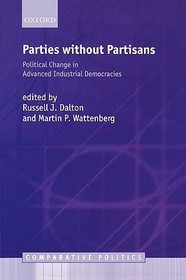
Parties Without Partisans
Political Change in Advanced Industrial Democracies
Series: Comparative Politics;
- Publisher's listprice GBP 64.00
-
28 896 Ft (27 520 Ft + 5% VAT)
The price is estimated because at the time of ordering we do not know what conversion rates will apply to HUF / product currency when the book arrives. In case HUF is weaker, the price increases slightly, in case HUF is stronger, the price goes lower slightly.
- Discount 10% (cc. 2 890 Ft off)
- Discounted price 26 006 Ft (24 768 Ft + 5% VAT)
Subcribe now and take benefit of a favourable price.
Subscribe
28 896 Ft

Availability
printed on demand
Why don't you give exact delivery time?
Delivery time is estimated on our previous experiences. We give estimations only, because we order from outside Hungary, and the delivery time mainly depends on how quickly the publisher supplies the book. Faster or slower deliveries both happen, but we do our best to supply as quickly as possible.
Product details:
- Edition number New ed
- Publisher OUP Oxford
- Date of Publication 14 March 2002
- ISBN 9780199253098
- Binding Paperback
- No. of pages330 pages
- Size 233x156x17 mm
- Weight 483 g
- Language English
- Illustrations tables 0
Categories
Short description:
This book provides the most comprehensive analysis to date of the roles that political parties perform in twenty OECD nations. It finds that parties continue to exercise their traditional roles in organizing elections and structuring the government process, but they are losing the allegiance of a public that is increasingly non-partisan and sceptical about
political parties as institutions. These findings lead to a discussion about the changing nature of representation democracy as these nations enter the 21st Century.
Long description:
If democracy without political parties is unthinkable, what would happen if the role of political parties if the democratic process is weakened? The ongoing debate about the vitality of political parties is also a debate about the vitality of representative democracy. Leading scholars in the field of party research assess the evidence for partisan decline or adaptation for the OECD nations in this book. It documents the broadscale erosion of the public's partisan identities in virtually all advanced industrial democracies. Partisan dealignment is diminishing involvement in electoral politics, and for those who participate it leads to more volatility in their voting choices, an openness to new political appeals, and less predictablity in their party preferences. Political parties have adapted to partisan dealignment by strengthening their internal organizational structures and partially isolating themselves from the ebbs and flows of electoral politics. Centralized, professionalized parties with short time horizons have replaced the ideologically-driven mass parties of the past. This study also examines the role of parties within government, and finds that parties have retained their traditional roles in structuring legislative action and the function of government-further evidence that party organizations are insulating themselves from the changes transforming democratic publics. Parties without Partisans is the most comprehensive cross-national study of parties in advanced industrial democracies in all of their forms -- in electoral politics, as organizations, and in government. Its findings chart both how representative democracy has been transformed in the later half of the 20th Century, as well as what the new style of democratic politics is likely to look like in the 21st Century.
'...this is a very good book. Serious students of political parties, and indeed anyone interested in the challenges facing modern electoral democracies, will want to read it ... The editors deserve much credit for producing that rarest of academic products - a genuinely integrated collection in which the whole is more than its (very substantial) parts.'
Table of Contents:
Introduction
Unthinkable Deomocracy: Political Change in Advanced Industrial Democracies
Part I. Parties in the Electorate
The Decline of Party Identification
The Consequences of Partisan Dealignment
The Decline of Party Mobilization
Part II. Parties as Political Organizations
Parties without Members? Party Organizations in a Changing Electoral Environment
Political Parties as Campaign Organizations
From Social Integration to Electoral Contestination: The Changing Distribution of Power within Political Parties
Part III. Parties in Government
Parties in Legislature: Two Competing Explanations
Parties at the Core of Government
From Platform Declarations to Policy Outcomes: Changing Party Profiles and Partisan Influence over Policy
On the Primacy of Party in Government: Why Legislative Parties Can Survive Party Decline in the Electorate
Conclusion
Partisan Change and the Democratic Process

