

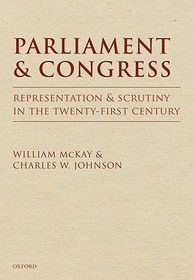
Parliament and Congress
Representation and Scrutiny in the Twenty-first Century
- Publisher's listprice GBP 135.00
-
60 952 Ft (58 050 Ft + 5% VAT)
The price is estimated because at the time of ordering we do not know what conversion rates will apply to HUF / product currency when the book arrives. In case HUF is weaker, the price increases slightly, in case HUF is stronger, the price goes lower slightly.
- Discount 10% (cc. 6 095 Ft off)
- Discounted price 54 857 Ft (52 245 Ft + 5% VAT)
Subcribe now and take benefit of a favourable price.
Subscribe
60 952 Ft

Availability
printed on demand
Why don't you give exact delivery time?
Delivery time is estimated on our previous experiences. We give estimations only, because we order from outside Hungary, and the delivery time mainly depends on how quickly the publisher supplies the book. Faster or slower deliveries both happen, but we do our best to supply as quickly as possible.
Product details:
- Publisher OUP Oxford
- Date of Publication 3 June 2010
- ISBN 9780199273621
- Binding Hardback
- No. of pages614 pages
- Size 252x178x38 mm
- Weight 1196 g
- Language English 0
Categories
Long description:
The constitutional background of both legislatures and their procedures are described and where possible compared. Currently unsolved problems often have much in common, in vexed areas such as ethics requirements or how procedural rules permit minorities fair access to legislative time before majorities prevail. British successes include the enhanced authority and effectiveness of select committees and the acquisition of more debating time by the creation of a parallel Chamber. Unsolved problems at Westminster begin with the powers and status of the Lords, and go on through the search for more effective review of EU activities, adapting parliamentary scrutiny to more sophisticated government financial information, and making better use of legislative time without diminishing back-bench rights.
The accelerated pace and extent of procedural changes in Congress is problematic. Constant pursuit of campaign funds, increased party exploitation of Members' ethical shortcomings, and partisan reapportionments, have diminished collegiality and compromise. Business is conducted with greater predictability, with fewer quorum calls, postponement and clustering of votes, and by utilization of ad hoc special orders, often in derogation of openness and minority rights in the House. Minority complaints have been frequent and occasionally extreme. Conversely constant filibuster threats in the Senate have enhanced minority party power there. An 'inverse ratio' between the greater complexity, importance, and urgency of pending legislation on the one hand, and diminution of deliberative capacity, fairness. and transparency on the other, has been repeatedly demonstrated, especially at the stage of final compromises between the Houses.
The strengths of this new work are many ... notable and praiseworthy for its clarity and honesty.
Table of Contents:
Preface
Introduction
Basic Constitutional Distinctions
The Four Houses
Representatives, Members, Lords and Senators
Procedural Basics
Power of the Purse
Scrutiny and Oversight
Committees
Legislation
Privilege and Contempt
Ethics and Standards
Conclusion
Annex of Tables
Index

