

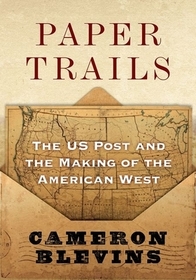
Paper Trails
The US Post and the Making of the American West
- Publisher's listprice GBP 28.99
-
13 088 Ft (12 465 Ft + 5% VAT)
The price is estimated because at the time of ordering we do not know what conversion rates will apply to HUF / product currency when the book arrives. In case HUF is weaker, the price increases slightly, in case HUF is stronger, the price goes lower slightly.
- Discount 10% (cc. 1 309 Ft off)
- Discounted price 11 779 Ft (11 219 Ft + 5% VAT)
Subcribe now and take benefit of a favourable price.
Subscribe
13 088 Ft

Availability
Estimated delivery time: In stock at the publisher, but not at Prospero's office. Delivery time approx. 3-5 weeks.
Not in stock at Prospero.
Why don't you give exact delivery time?
Delivery time is estimated on our previous experiences. We give estimations only, because we order from outside Hungary, and the delivery time mainly depends on how quickly the publisher supplies the book. Faster or slower deliveries both happen, but we do our best to supply as quickly as possible.
Product details:
- Publisher OUP USA
- Date of Publication 9 September 2021
- ISBN 9780190053673
- Binding Hardback
- No. of pages248 pages
- Size 175x257x22 mm
- Weight 658 g
- Language English
- Illustrations 49 halftones 119
Categories
Short description:
Between the 1860s and the early 1900s, the western United States underwent one of the most dramatic reorganizations of people, land, capital, and resources in American history. Paper Trails tells a new history of the nation's western expansion by shining a light on the era's largest government institution: the US Post.
MoreLong description:
A groundbreaking history of how the US Post made the nineteenth-century American West.
There were five times as many post offices in the United States in 1899 than there are McDonald's restaurants today. During an era of supposedly limited federal government, the United States operated the most expansive national postal system in the world.
In this cutting-edge interpretation of the late nineteenth-century United States, Cameron Blevins argues that the US Post wove together two of the era's defining projects: western expansion and the growth of state power. Between the 1860s and the early 1900s, the western United States underwent a truly dramatic reorganization of people, land, capital, and resources. It had taken Anglo-Americans the better part of two hundred years to occupy the eastern half of the continent, yet they occupied the West within a single generation. As millions of settlers moved into the region, they relied on letters and newspapers, magazines and pamphlets, petitions and money orders to stay connected to the wider world.
Paper Trails maps the spread of the US Post using a dataset of more than 100,000 post offices, revealing a new picture of the federal government in the West. The western postal network bore little resemblance to the civil service bureaucracies typically associated with government institutions. Instead, the US Post grafted public mail service onto private businesses, contracting with stagecoach companies to carry the mail and paying local merchants to distribute letters from their stores. These arrangements allowed the US Post to rapidly spin out a vast and ephemeral web of postal infrastructure to thousands of distant places.
The postal network's sprawling geography and localized operations forces a reconsideration of the American state, its history, and the ways in which it exercised power.
Paper Trails brings impressive depth and richness to historians long-standing interest in how federal power shaped the North American West....Blevinss study calls attention to infrastructures role in defining territory and supporting white settlement. Paper Trails will be of particular interest to historians of the nineteenth-century United States and the North American West, spatial historians and digital practitioners, and scholars of settler colonialism and state power....Paper Trails represents the leading edge of digital history. By combining large-scale data analysis with archival research and close reading, Blevins delivers unexpected insights into the postal system, the people who used it, and the American West they made.
Table of Contents:
Acknowledgments
Note on Methods
Introduction: The Gossamer Network
1. Geography and State Power
2. Stories and Structures
3. Postal Maps, 1860- 83
4. Mail Routes and the Costs of Expansion, 1866- 83
5. The Post Office Window, 1880- 92
6. Money Orders and National Integration, 1864- 95
7. Rural Free Delivery, 1896- 1913
Conclusion: The Modern American State
Notes
Index

