

- Publisher's listprice GBP 8.99
-
4 294 Ft (4 090 Ft + 5% VAT)
The price is estimated because at the time of ordering we do not know what conversion rates will apply to HUF / product currency when the book arrives. In case HUF is weaker, the price increases slightly, in case HUF is stronger, the price goes lower slightly.
- Discount 10% (cc. 429 Ft off)
- Discounted price 3 865 Ft (3 681 Ft + 5% VAT)
Subcribe now and take benefit of a favourable price.
Subscribe
4 294 Ft

Availability
Estimated delivery time: In stock at the publisher, but not at Prospero's office. Delivery time approx. 3-5 weeks.
Not in stock at Prospero.
Why don't you give exact delivery time?
Delivery time is estimated on our previous experiences. We give estimations only, because we order from outside Hungary, and the delivery time mainly depends on how quickly the publisher supplies the book. Faster or slower deliveries both happen, but we do our best to supply as quickly as possible.
Product details:
- Edition number 2
- Publisher OUP USA
- Date of Publication 27 December 2024
- ISBN 9780197762004
- Binding Paperback
- No. of pages184 pages
- Size 175x112x12 mm
- Weight 159 g
- Language English
- Illustrations 10 illus. 574
Categories
Short description:
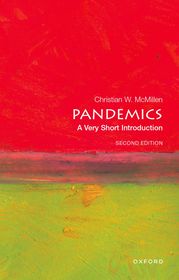
A concise and comprehensive account of pandemics throughout human history, including plague, tubercolosis, smallpox, malaria, cholera, HIV, and COVID-19.
MoreLong description:
The 2014 Ebola epidemic demonstrated the power of pandemics and their ability not only to destroy lives locally but also to capture the imagination and terrify the world. In 2019 and the years that followed, the coronavirus pandemic infected every continent and took the lives of millions. In this updated edition, Christian W. McMillen provides a concise yet comprehensive account of pandemics throughout human history, illustrating how pandemic disease has shaped history and, at the same time, social behavior has influenced pandemic disease. Extremely interesting from a medical standpoint, the study of pandemics also provides unexpected, broader insights into culture and politics.
This Very Short Introduction describes history's major pandemics--plague, tuberculosis, malaria, smallpox, cholera, influenza, and HIV/AIDS--highlighting how each disease's biological characteristics affected its pandemic development. McMillen discusses state responses to pandemics, such as quarantine, isolation, travel restrictions, and other forms of social control, and pays special attention to the rise of public health and the explosion of medical research in the wake of pandemics, especially as the germ theory of disease emerged in the late nineteenth and early twentieth centuries. Today, medicine is able to control all of these diseases, yet some of them are still devastating in much of the developing world. By assessing the relationship between poverty and disease and the geography of epidemics, McMillen offers an outspoken and thought-provoking point of view on the necessity for global governments to learn from past experiences and proactively cooperate to prevent any future epidemic.
With the recent surge of epidemic research and literature, this book distinguishes itself by being concise, precise, accurate, and effective. It is an introductory read that acts as both a summation of epidemic history as well as an invitation to dive deeper into the ongoing understanding of epidemics.
Table of Contents:
Chapter 1: Plague
Chapter 2: Smallpox
Chapter 3: Malaria
Chapter 4: Cholera
Chapter 5: Tuberculosis
Chapter 6: Influenza
Chapter 7: HIV/AIDS
Chapter 8: COVID-19
References
Further reading
Index

