

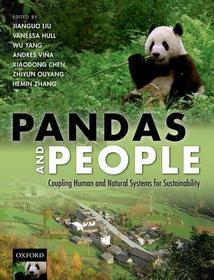
Pandas and People
Coupling Human and Natural Systems for Sustainability
- Publisher's listprice GBP 155.00
-
69 982 Ft (66 650 Ft + 5% VAT)
The price is estimated because at the time of ordering we do not know what conversion rates will apply to HUF / product currency when the book arrives. In case HUF is weaker, the price increases slightly, in case HUF is stronger, the price goes lower slightly.
- Discount 10% (cc. 6 998 Ft off)
- Discounted price 62 984 Ft (59 985 Ft + 5% VAT)
Subcribe now and take benefit of a favourable price.
Subscribe
69 982 Ft

Availability
printed on demand
Why don't you give exact delivery time?
Delivery time is estimated on our previous experiences. We give estimations only, because we order from outside Hungary, and the delivery time mainly depends on how quickly the publisher supplies the book. Faster or slower deliveries both happen, but we do our best to supply as quickly as possible.
Product details:
- Publisher OUP Oxford
- Date of Publication 14 January 2016
- ISBN 9780198703549
- Binding Hardback
- No. of pages296 pages
- Size 247x197x21 mm
- Weight 854 g
- Language English 0
Categories
Short description:
This brings together the latest research on coupled human and natural systems (CHANS), featuring a classic long-term interdisciplinary research project and model coupled human-nature system - the Wolong Nature Reserve of China, which contains one of the largest populations of the world-famous endangered giant pandas.
MoreLong description:
Understanding the complex relationships between humans and the natural world is essential for achieving environmental sustainability and improving human well-being, yet many studies are unable to reveal complex interactions and hidden trends. This is the first book to synthesize the findings and approaches of long-term integrated research in a model coupled human and natural system, and to illustrate their applications to regional, national, and global scales. It features a classic long-term interdisciplinary research project in the Wolong Nature Reserve of China, which contains one of the largest wild populations of the world-famous endangered giant pandas. Bringing together a team of contributors from both the natural and social sciences, this book explores how a long-term interdisciplinary and model system approach is essential to uncover the common patterns and mechanisms of coupled systems, to develop ideas and methods for studying and managing other coupled systems, and ultimately to contribute to the development of theories about coupled systems for sustainability.
Pandas and People will be essential reading for scholars interested in the interface of the natural and social sciences, including ecologists, conservation biologists, environmental scientists, sustainability scientists, wildlife biologists, forest scientists, sociologists, anthropologists, economists, and political scientists. It will also be a valuable reference for policy makers, natural resource managers, and graduate students.
No work like this has crossed my desk in the 10 years I have been reviewing books in the field, and I feel sure it will come to be viewed as landmark in wildlife:human interactions.
Table of Contents:
PART I: EMPIRICAL AND THEORETICAL FOUNDATIONS
A Global Icon for Nature in the Human-Dominated World
Framing Sustainability of Coupled Human and Natural Systems
PART II: MODEL COUPLED HUMAN AND NATURAL SYSTEM
Peek into a Home for Pandas and People
Pandas-People Coexistence and Competition
Quantifying Human Dependence on Ecosystem Services
Landscape Changes in Space and Time
Panda Habitat Transition
Demographic Decisions and Cascading Consequences
Dynamics of Economic Transformation
Energy Transition from Fuelwood to Electricity
Social Capital and Social Norms Shape Human-Nature Interactions
Vulnerability and Adaptation to Natural Disasters
Human-Nature Interactions under Policy Interventions
Toward a Sustainable Future
PART III: ACROSS LOCAL TO GLOBAL COUPLED HUMAN AND NATURAL SYSTEMS
Applying Methods from Local to Regional Scales
Cross-Site Synthesis of Complexity in Coupled Human and Natural Systems
Human-Nature Interactions over Distances
Lessons from Local Studies for Global Sustainability
PART IV: PERSPECTIVES
Future Directions for Coupled Human and Natural Systems Research

