

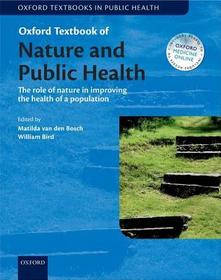
Oxford Textbook of Nature and Public Health
The role of nature in improving the health of a population
Series: Oxford Textbooks in Public Health;
- Publisher's listprice GBP 60.00
-
28 665 Ft (27 300 Ft + 5% VAT)
The price is estimated because at the time of ordering we do not know what conversion rates will apply to HUF / product currency when the book arrives. In case HUF is weaker, the price increases slightly, in case HUF is stronger, the price goes lower slightly.
- Discount 10% (cc. 2 867 Ft off)
- Discounted price 25 799 Ft (24 570 Ft + 5% VAT)
Subcribe now and take benefit of a favourable price.
Subscribe
28 665 Ft

Availability
printed on demand
Why don't you give exact delivery time?
Delivery time is estimated on our previous experiences. We give estimations only, because we order from outside Hungary, and the delivery time mainly depends on how quickly the publisher supplies the book. Faster or slower deliveries both happen, but we do our best to supply as quickly as possible.
Product details:
- Publisher OUP Oxford
- Date of Publication 4 January 2018
- ISBN 9780198725916
- Binding Paperback
- No. of pages360 pages
- Size 278x220x15 mm
- Weight 900 g
- Language English 0
Categories
Short description:
The 'Oxford Textbook of Nature and Public Health' focuses on the role of nature for our health and wellbeing by demonstrating the multiple health benefits that can be gained from nature. Highlighting the need for healthy nature management, and to make public health issues part of all society development policies.
MoreLong description:
Human beings have always been affected by their surroundings. There are various health benefits linked to being able to access to nature; including increased physical activity, stress recovery, and the stimulation of child cognitive development. The Oxford Textbook of Nature and Public Health provides a broad and inclusive picture of the relationship between our own health and the natural environment. All aspects of this unique relationship are covered, ranging from disease prevention through physical activity in green spaces to innovative ecosystem services, such as climate change adaptation by urban trees. Potential hazardous consequences are also discussed including natural disasters, vector-borne pathogens, and allergies.
This book analyses the complexity of our human interaction with nature and includes sections for example epigenetics, stress physiology, and impact assessments. These topics are all interconnected and fundamental for reaching a full understanding of the role of nature in public health and wellbeing.
Much of the recent literature on environmental health has primarily described potential threats from our natural surroundings. The Oxford Textbook of Nature and Public Health instead focuses on how nature can positively impact our health and wellbeing, and how much we risk losing by destroying it. The all-inclusive approach provides a comprehensive and complete coverage of the role of nature in public health, making this textbook invaluable reading for health professionals, students, and researchers within public health, environmental health, and complementary medicine.
Table of Contents:
Section 1: Why is nature a health factor?
Setting the scene and how to read the book
A life course approach to public health: why early life matters
Systems thinking for global health and strategic sustainable development
The physiology of stress and stress recovery
Unifying mechanisms: nature deficiency and chronic stress and inflammation
Section 2: How nature can affect health- theories and mechanisms
Environmental psychology
Therapeutic landscapes, restorative environments, place attachment, and wellbeing
Microbes, the immune system and the health benefits of exposure to the natural environment
Environmental enrichment: neurophysiological responses and consequences for health
Biological mechanisms and physiological responses to sensory impact from nature
The role of nature and environment in behavioural medicine
Section 3: Public health impact of nature contact - pathways to health promotion and disease prevention
Promoting physical activity reducing obesity and NCDs
Preventing stress and promoting mental health
Promoting social cohesion and social capital increasing wellbeing
Section 4: Public health impact of nature contact- intervention and rehabilitation
Using nature as a treatment option
The human-animal bond and animal assisted intervention
Similarities, disparities, and synergies with other complex interventions stress as a common pathway
Section 5: Public health impact of varied landscapes and environments
The great outdoors: forests, wilderness, and public health
Blue landscapes and public health
Technological nature and human wellbeing
Section 6: Varied populations and interactions with nature
Children and nature
Nature-based treatments as an adjunctive therapy for anxiety among elderly
Vulnerable populations, health inequalities, and nature
Responses to nature from populations of varied cultural background
Section 7: Threats, environmental change, and unintended consequences of nature - protecting health and reducing environmental hazards
Allergenic pollen emissions from vegetation threats and prevention
Vector-borne diseases and poisonous plants
The health impact of natural disasters
Risk and the perception of risk in interactions with nature
Population health deficits due to biodiversity loss, climate change, and other environmental degradation
Section 8: The nature of the city
The shift from natural living environments to urban population-based and neurobiological implications for public health
Urban landscapes and public health
Nature in buildings and health design
Green infrastructure - approach and public health benefits
Ecosystem services and health benefits an urban perspective
The healthy settings approach: healthy cities and environmental health indicators
Section 9: Natural public health across the world
Africa and environmental health trends
Latin America and the environmental health movement
Healthy islands
Section 10: Bringing nature into public health plans and actions
The role of the health professional
The role of environmental law
Environmental assessment and health impact assessment
Quantifying and valuing the role of trees and forests on environmental quality and human health
The role of civil society and organizations

