

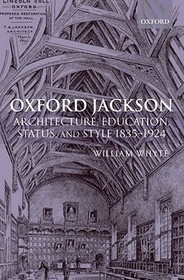
Oxford Jackson
Architecture, Education, Status, and Style 1835-1924
Series: Oxford Historical Monographs;
- Publisher's listprice GBP 97.00
-
43 795 Ft (41 710 Ft + 5% VAT)
The price is estimated because at the time of ordering we do not know what conversion rates will apply to HUF / product currency when the book arrives. In case HUF is weaker, the price increases slightly, in case HUF is stronger, the price goes lower slightly.
- Discount 10% (cc. 4 379 Ft off)
- Discounted price 39 416 Ft (37 539 Ft + 5% VAT)
Subcribe now and take benefit of a favourable price.
Subscribe
43 795 Ft

Availability
printed on demand
Why don't you give exact delivery time?
Delivery time is estimated on our previous experiences. We give estimations only, because we order from outside Hungary, and the delivery time mainly depends on how quickly the publisher supplies the book. Faster or slower deliveries both happen, but we do our best to supply as quickly as possible.
Product details:
- Publisher OUP Oxford
- Date of Publication 31 August 2006
- ISBN 9780199296583
- Binding Hardback
- No. of pages284 pages
- Size 242x164x23 mm
- Weight 585 g
- Language English
- Illustrations 100 in-text half-tones 0
Categories
Short description:
This is the first biography of T. G. Jackson, an architect who transformed the image of Oxford, rebuilt public schools, and became a leading architect of the arts and crafts movement. Although many of his buildings are famous, until now he has been little known. Yet his work illuminates a whole society as well as an individual.
MoreLong description:
In the late nineteenth century one man changed Oxford forever. T. G. Jackson built the Examination Schools, the Bridge of Sighs, worked at a dozen colleges, and restored a score of other Oxford icons. He also built for many of the major public schools, for the University of Cambridge, and at the Inns of Court. A friend of William Morris, he was a pioneering member of the arts and crafts moment. A distinguished historian, he also restored dozens of houses and churches - and ensured the survival of Winchester Cathedral. As an architectural theorist he was a leader of the generation that rejected the Gothic Revival and sought to develop a new and modern style of building.
Drawing on extensive archival work, and illustrated with a hundred images, this is the first in-depth analysis of Jackson's career ever written. It sheds light on a little-known architect and reveals that his buildings, his books, and his work as an arts and craftsman were not just important in their own right, they were also part of a wider social change. Jackson was the architect of choice for a particular group of people, for the 'intellectual aristocracy' of late Victorian England. His buildings were a means by which they could articulate their identity and demonstrate their distinctiveness. They reformed the universities and the schools whilst he refashioned their image.
Essential reading for anyone interested in Victorian architecture and nineteenth-century society, this book will also be of interest to all those who know and love Oxford or Cambridge.
In this attractive book, William Whyte has wisely and ably brought Sir Thomas Graham Jackson out of the peculiar obscurity to which much of the twentieth century consigned him.
Table of Contents:
Introduction
'Recording our Eclectic Age': Jackson and the Dilemma of Style
'The Unity of Art': Jackson and the Arts and Crafts
'The Maker of Modern Oxford': Jackson and the Architecture of Progress
'In the Shadow of Anglo-Jackson': Jackson and the Public Schools
'Cambridge at Last!': Jackson and the Architecture of Science
'An Intellectual Aristocracy': Jackson, his Clients, and their World
Conclusion
Bibliography
Index

