

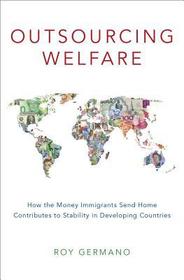
Outsourcing Welfare
How the Money Immigrants Send Home Contributes to Stability in Developing Countries
- Publisher's listprice GBP 34.49
-
15 572 Ft (14 830 Ft + 5% VAT)
The price is estimated because at the time of ordering we do not know what conversion rates will apply to HUF / product currency when the book arrives. In case HUF is weaker, the price increases slightly, in case HUF is stronger, the price goes lower slightly.
- Discount 10% (cc. 1 558 Ft off)
- Discounted price 14 014 Ft (13 347 Ft + 5% VAT)
Subcribe now and take benefit of a favourable price.
Subscribe
15 572 Ft

Availability
printed on demand
Why don't you give exact delivery time?
Delivery time is estimated on our previous experiences. We give estimations only, because we order from outside Hungary, and the delivery time mainly depends on how quickly the publisher supplies the book. Faster or slower deliveries both happen, but we do our best to supply as quickly as possible.
Product details:
- Publisher OUP USA
- Date of Publication 10 May 2018
- ISBN 9780190862848
- Binding Hardback
- No. of pages240 pages
- Size 157x239x22 mm
- Weight 431 g
- Language English 0
Categories
Short description:
In order to meet the International Monetary Fund's debt-reduction guidelines, many developing country governments have had to retrenth their social welfare systems. This book is about how remittances--the hundreds of billions of dollars international migrants send to family members in their home countries each year--are helping to fill this welfare gap and prevent civil unrest in developing countries. Looking particularly at Mexico, with supplemental cases in Africa, the Middle East, the Caribbean, and Latin America, the author argues that counting on expatriates to send money home has become a de facto social welfare policy in many cash-strapped developing countries whose economic policies are guided by neoliberal orthodoxy.
MoreLong description:
Rising food prices, climate change, and the ravages of global capitalism have made the poor increasingly vulnerable to economic crises. At the same time, the governments of many developing countries have adopted austerity measures that leave their citizens without a safety net in times of need. This combination poses a potent threat to social and political stability throughout the developing world. How do the poor cope with economic crises when their governments fail to guarantee social welfare? How do societies keep from fracturing under the weight of economic grievances and civil unrest?
Outsourcing Welfare argues that the answers to these questions lie with remittances, the hundreds of billions of dollars that international migrants send to their home countries. Remittances are a leading source of income in dozens of developing economies and a critical lifeline that millions of families use to pay for food, healthcare, clothing, and other basics. In the absence of adequate government social protections, remittances insulate poor families from the full pain of economic crises, and in doing so, reduce the severity of grievances that fuel populist anger, civil unrest, and political instability.
Through stories from his fieldwork in Mexico and Central America and analyses of data from Africa, Latin America, the Caribbean, and the Middle East, Roy Germano shows how remittances buffer economic shocks, contribute to economic optimism, and dampen the threat of popular discontent during economic crises. Germano argues that remittances perform a social, economic, and political function that is strikingly similar to social spending, and that counting on people to migrate and send money home has become a de facto social welfare policy in many developing countries.
This illuminating book addresses an important but often overlooked consequence of international migration: remittances sent by immigrants to relatives in their countries of origin.
Table of Contents:
Table of Contents
Acknowledgements
Chapter 1: Remittances and the Politics of Austerity
Chapter 2: Outsourcing Social Welfare: How Migrants Replaced the State during Mexico's Market Transition
Chapter 3: How Remittances Prevent Social Unrest: Evidence from the Mexican Countryside
Chapter 4: Optimism in Times of Crisis: Remittances and Economic Security in Africa, the Caribbean, Latin America, and the Middle East
Chapter 5: They Came Banging Pots and Pans: Remittances and Government Approval in Sub-Saharan Africa during the Food Crisis
Chapter 6: No Left Turn: Remittances and Incumbent Support in Mexico's Closely-Contested 2006 Presidential Election
Chapter 7: Conclusion
Methodological Appendix
Statistical Appendix
Notes
Bibliography
Index

