

-
GET 20% OFF
- Publisher's listprice GBP 16.99
-
7 670 Ft (7 305 Ft + 5% VAT)
The price is estimated because at the time of ordering we do not know what conversion rates will apply to HUF / product currency when the book arrives. In case HUF is weaker, the price increases slightly, in case HUF is stronger, the price goes lower slightly.
- Discount 20% (cc. 1 534 Ft off)
- Discounted price 6 136 Ft (5 844 Ft + 5% VAT)
- Discount is valid until: 31 October 2026
6 136 Ft

Availability
Uncertain availability. Please turn to our customer service.
Why don't you give exact delivery time?
Delivery time is estimated on our previous experiences. We give estimations only, because we order from outside Hungary, and the delivery time mainly depends on how quickly the publisher supplies the book. Faster or slower deliveries both happen, but we do our best to supply as quickly as possible.
Product details:
- Publisher Random House
- Date of Publication 6 October 2016
- Number of Volumes B-format paperback
- ISBN 9780099502838
- Binding Paperback
- No. of pages496 pages
- Size 198x129x30 mm
- Weight 364 g
- Language English 0
Categories
Long description:
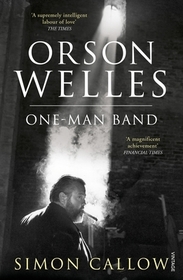
In One-Man Band, the third volume in his epic survey of Orson Welles’ life and work, Simon Callow again probes in comprehensive and penetrating detail into one of the most complex artists of the twentieth century, looking closely at the triumphs and failures of an ambitious one-man assault on one medium after another – theatre, radio, film, television, even, at one point, ballet – in each of which his radical and original approach opened up new directions and hitherto unglimpsed possibilities.
The book begins with Welles’ self-exile from America, and his realisation that he could only function happily as an independent film-maker, a one-man band; by 1964, he had filmed Othello, which took three years to complete, Mr Arkadin, the biggest conundrum in his output, and his masterpiece Chimes at Midnight, as well as Touch of Evil, his sole return to Hollywood and, like all too many of his films, wrested from his grasp and re-edited. Along the way he made inroads into the fledgling medium of television and a number of stage plays, including Moby-Dick, considered by theatre historians to be one of the seminal productions of the century. Meanwhile, his private life was as dramatic as his professional life.
The book shows what it was like to be around Welles, and, with a precision rarely attempted before, what it was like to be him, in which lies the answer to the old riddle: whatever happened to Orson Welles?

