

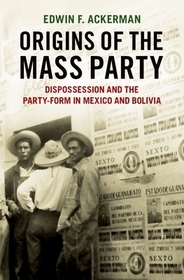
Origins of the Mass Party
Dispossession and the Party-Form in Mexico and Bolivia in Comparative Perspective
- Publisher's listprice GBP 74.00
-
33 411 Ft (31 820 Ft + 5% VAT)
The price is estimated because at the time of ordering we do not know what conversion rates will apply to HUF / product currency when the book arrives. In case HUF is weaker, the price increases slightly, in case HUF is stronger, the price goes lower slightly.
- Discount 10% (cc. 3 341 Ft off)
- Discounted price 30 070 Ft (28 638 Ft + 5% VAT)
Subcribe now and take benefit of a favourable price.
Subscribe
33 411 Ft

Availability
Estimated delivery time: In stock at the publisher, but not at Prospero's office. Delivery time approx. 3-5 weeks.
Not in stock at Prospero.
Why don't you give exact delivery time?
Delivery time is estimated on our previous experiences. We give estimations only, because we order from outside Hungary, and the delivery time mainly depends on how quickly the publisher supplies the book. Faster or slower deliveries both happen, but we do our best to supply as quickly as possible.
Product details:
- Publisher OUP USA
- Date of Publication 24 March 2022
- ISBN 9780197576502
- Binding Hardback
- No. of pages208 pages
- Size 246x160x25 mm
- Weight 431 g
- Language English
- Illustrations 5 b/w figures; 3 tables 190
Categories
Short description:
How and why did parties emerge historically? In Origin of the Mass Party, Edwin F. Ackerman develops a theory about the emergence of the party as a type of political organization through a careful comparison between the scenarios in post-revolutionary Mexico and Bolivia, and includes a chapter as well on iconic Western European mass parties.
MoreLong description:
In Mexico (1921) and Bolivia (1952), nationalist insurrections with armies largely composed of peasants triumphed over oligarchical regimes. In the aftermath of these uprisings, parties led by members of an urban middle-class intelligentsia adopting a populist agrarian discourse attempted to incorporate this predominantly peasant base. The outcomes of these efforts were, however, radically different.
In Origins of the Mass Party, Edwin F. Ackerman tells the stories of the Partido Revolucionario Institucional (PRI) as a mass party in post-revolutionary Mexico (1929-1946), and the attempt but ultimate failure of Bolivia's Movimiento Nacionalista Revolucionario (MNR) (1953-1964) to do the same. As he shows, Mexico's PRI successfully mobilized peasants into party politics, translating the insurrectionary effervescence of the peasantry into organizational incorporation. Bolivia's MNR, in contrast, attempted but failed to undertake a homologous process. To shed light on why this happened, Ackerman examines the historical conditions necessary for the emergence of the mass political parties, offering insights into the persistence of parties over time by linking the economic dispossession that makes it possible to articulate individuals into a political bloc, and the political dispossession that produces professional politicians to undertake articulation and create constituencies. He argues that parties are the predominant form of political mobilization at a global scale, even in an age of dissatisfaction with conventional organization and persistent experimentation with new forms of association.
Both comparative and historical in scope, Origins of the Mass Party seeks to show why there is such a strong bond between the party-form and the contemporary world by highlighting the connection between capitalism, modern-state formation, and the party-form.
The argument is insightful and presented clearly...Recommended. Undergraduates through faculty.
Table of Contents:
Acknowledgements
Introduction
Part I
Chapter 1: Mexico and Bolivia in Comparative Perspective and the Sociology of Party Formation
Chapter 2: Dispossession and the Mass Party
Part II
Chapter 3: The Emergence of the PRI in Mexico
Chapter 4: The Failure of Party Formation in Bolivia
Part III
Chapter 5: Dispossession and Party Formation in Broader Comparative Perspective: Germany's SPD and the (Absent) British Labour Party
Conclusion
Appendix
Index

