

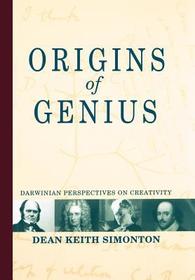
Origins of Genius
Darwinian Perspectives on Creativity
- Publisher's listprice GBP 87.00
-
39 280 Ft (37 410 Ft + 5% VAT)
The price is estimated because at the time of ordering we do not know what conversion rates will apply to HUF / product currency when the book arrives. In case HUF is weaker, the price increases slightly, in case HUF is stronger, the price goes lower slightly.
- Discount 10% (cc. 3 928 Ft off)
- Discounted price 35 352 Ft (33 669 Ft + 5% VAT)
Subcribe now and take benefit of a favourable price.
Subscribe
39 280 Ft

Availability
printed on demand
Why don't you give exact delivery time?
Delivery time is estimated on our previous experiences. We give estimations only, because we order from outside Hungary, and the delivery time mainly depends on how quickly the publisher supplies the book. Faster or slower deliveries both happen, but we do our best to supply as quickly as possible.
Product details:
- Publisher OUP USA
- Date of Publication 30 September 1999
- ISBN 9780195128796
- Binding Hardback
- No. of pages320 pages
- Size 241x163x28 mm
- Weight 594 g
- Language English
- Illustrations 4 line illustrations 0
Categories
Short description:
In Origins of Genius, Dean Simonton reveals how Darwin's theory of natural selection can be used to explain the psychology of creative geniuses. Simonton not only uses Darwin's ideas to explain the creative genius of many eminent scientists and artists, but applies it extensively to Darwin himself.
MoreLong description:
How can we account for the sudden appearance of such dazzling artists and scientists as Mozart, Shakespeare, Darwin, or Einstein? How can we define such genius? What conditions or personality traits seem to produce exceptionally creative people? Is the association between genius and madness really just a myth? These and many other questions are brilliantly illuminated in The Origins of Genius.
Dean Simonton convincingly argues that creativity can best be understood as a Darwinian process of variation and selection. The artist or scientist generates a wealth of ideas, and then subjects these ideas to aesthetic or scientific judgment, selecting only those that have the best chance to survive and reproduce. Indeed, the true test of genius is the ability to bequeath an impressive and influential body of work to future generations. Simonton draws on the latest research into creativity and explores such topics as the personality type of the genius, whether genius is genetic or produced by environment and education, the links between genius and mental illness (Darwin himself was emotionally and mentally unwell), the high incidence of childhood trauma, especially loss of a parent, amongst Nobel Prize winners, the importance of unconscious incubation in creative problem-solving, and much more. Simonton substantiates his theory by examining and quoting from the work of such eminent figures as Henri Poincare, W. H. Auden, Albert Einstein, Marie Curie, Charles Darwin, Niels Bohr, and many others.
For anyone intrigued by the spectacular feats of the human mind, The Origins of Genius offers a revolutionary new way of understanding the very nature of creativity.
"No scholar writing about genius and creativity has the breadth of knowledge of Dean Keith Simonton. His Darwinian perspective is provocative, intriguing, generative and important."--Howard Gardner, author of Frames of Mind: The Theory of Multiple Intelligences
Table of Contents:
Preface
Genius and Darwin
Cognition: What is the Creative Process?
Variation: How do Creators Differ from the Rest of Us?
Development: Is the Genius Born or Made?
Products: By What Works Shall We Know Them?
Groups: Creative Times, Places and Peoples?
Darwinian Genius
Notes
References
Index

