

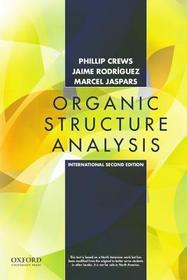
Organic Structure Analysis
- Publisher's listprice GBP 137.99
-
62 302 Ft (59 335 Ft + 5% VAT)
The price is estimated because at the time of ordering we do not know what conversion rates will apply to HUF / product currency when the book arrives. In case HUF is weaker, the price increases slightly, in case HUF is stronger, the price goes lower slightly.
- Discount 10% (cc. 6 230 Ft off)
- Discounted price 56 072 Ft (53 402 Ft + 5% VAT)
Subcribe now and take benefit of a favourable price.
Subscribe
62 302 Ft

Availability
Only to order.
Why don't you give exact delivery time?
Delivery time is estimated on our previous experiences. We give estimations only, because we order from outside Hungary, and the delivery time mainly depends on how quickly the publisher supplies the book. Faster or slower deliveries both happen, but we do our best to supply as quickly as possible.
Product details:
- Edition number 2
- Publisher OUP USA
- Date of Publication 28 October 2010
- ISBN 9780199733224
- Binding Paperback
- No. of pages576 pages
- Size 220x276x27 mm
- Weight 1284 g
- Language English 0
Categories
Long description:
Organic Spectroscopy is a standard chemistry course offered each year to large numbers of seniors and beginning graduate students. They learn to efficiently solve problems of molecular structure determination by an integrated use of four primary spectroscopic methods; NMR; mass spectrometry; infrared and ultraviolet. The problem solving approach used in the second edition follows the actual information flow used by practitioners solving molecular strustures and not the standard methods-based aooroach used in other texts.
In the ten years since the last edition published there have been significant changes in spectroscopic instrumentation and these are reflected throughout this text. New sections have been included where the first edition omitted coverage, and all chapters are updated with the most recent developments in the field. Major changes have been made in the pivotal chapters covering multipulse 1D and 2D nuclear magnetic resonance methods and the chapters covering mass spectrometric methods have been split from two into three to increase content on modern MS methodology. As examples in NMR, selective pulses and their uses, 15N 2D methods and computer assisted structure elucidation has been included and there is now a section on NOESY and ROESY. For MS the three chapters cover: core techniques and ionization processes; small and large molecule analysis and fragmentation processes.
A hallmark of this text is the focus on chemical structure and the text revolves around how relevant information regarding skeleton, functional groups and stereochemistry can be derived and the benefits/disadvantages of particular approaches. The straightforward writing style and use of illustrative examples, clearly reproduced spectra and a large number of problems make this text more accessible than ever.
Table of Contents:
Introduction to Nuclear Magnetic Resonance
Interpretation and Use of Proton and Carbon Chemical Shifts
Interpretation and Use of Proton or Carbon Coupling Constants
Multiple-Pulse and Multidimensional NMR Techniques
Mas Spectrometry: Core Techniques and Ionization Processes
Mass Spectrometry Analysis of Small and Large Molecules
Fragmentation Processes in Electron Ionization Mass Spectrometry
Infrared Spectroscopy
Optical and Chiroptical Techniques: Ultraviolet Spectroscopy
Strategies of Determining Structure and Stereochemistry: Spectroscopic Data Translated into Structures.
Problems in Organic Structure Analysis

