

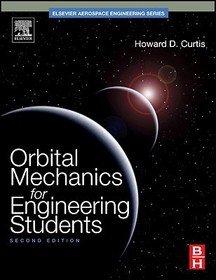
Orbital Mechanics for Engineering Students
Series: Aerospace Engineering;
- Publisher's listprice EUR 74.95
-
29 275 Ft (27 881 Ft + 5% VAT)
The price is estimated because at the time of ordering we do not know what conversion rates will apply to HUF / product currency when the book arrives. In case HUF is weaker, the price increases slightly, in case HUF is stronger, the price goes lower slightly.
- Discount 10% (cc. 2 927 Ft off)
- Discounted price 26 348 Ft (25 093 Ft + 5% VAT)
Subcribe now and take benefit of a favourable price.
Subscribe
29 275 Ft

Availability
Out of print
Why don't you give exact delivery time?
Delivery time is estimated on our previous experiences. We give estimations only, because we order from outside Hungary, and the delivery time mainly depends on how quickly the publisher supplies the book. Faster or slower deliveries both happen, but we do our best to supply as quickly as possible.
Product details:
- Edition number 2
- Publisher Elsevier Science
- Date of Publication 7 December 2009
- ISBN 9780123747785
- Binding Hardback
- No. of pages744 pages
- Size 234x190 mm
- Weight 1370 g
- Language English 0
Categories
Long description:
Orbital Mechanics for Engineering Students, Second Edition, provides an introduction to the basic concepts of space mechanics. These include vector kinematics in three dimensions; Newton's laws of motion and gravitation; relative motion; the vector-based solution of the classical two-body problem; derivation of Kepler's equations; orbits in three dimensions; preliminary orbit determination; and orbital maneuvers. The book also covers relative motion and the two-impulse rendezvous problem; interplanetary mission design using patched conics; rigid-body dynamics used to characterize the attitude of a space vehicle; satellite attitude dynamics; and the characteristics and design of multi-stage launch vehicles.
Each chapter begins with an outline of key concepts and concludes with problems that are based on the material covered. This text is written for undergraduates who are studying orbital mechanics for the first time and have completed courses in physics, dynamics, and mathematics, including differential equations and applied linear algebra. Graduate students, researchers, and experienced practitioners will also find useful review materials in the book.
MoreTable of Contents:
1. Dynamics of Point Masses;2. The Two-Body Problem;3. Orbital Position as a Function of Time;4. Orbits in Three Dimensions;5. Preliminary Orbit Determination;6. Orbital Maneuvers;7. Relative Motion and Rendezvous;8. Interplanetary Trajectories;9. Rigid-Body Dynamics;10. Satellite Attitude Dynamics;11. Rocket Vehicle Dynamics;Appx A. Physical Data;Appx B. A Road Map;Appx C. Numerical Integration of the n-Body Equations of Motion;Appx D. Matlab Algorithms;Appx E. Gravitational Potential Energy of a Sphere
More
