

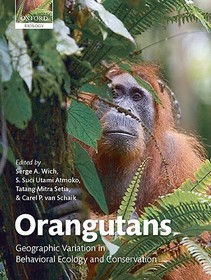
Orangutans
Geographic Variation in Behavioral Ecology and Conservation
- Publisher's listprice GBP 107.50
-
51 358 Ft (48 912 Ft + 5% VAT)
The price is estimated because at the time of ordering we do not know what conversion rates will apply to HUF / product currency when the book arrives. In case HUF is weaker, the price increases slightly, in case HUF is stronger, the price goes lower slightly.
- Discount 10% (cc. 5 136 Ft off)
- Discounted price 46 222 Ft (44 021 Ft + 5% VAT)
Subcribe now and take benefit of a favourable price.
Subscribe
51 358 Ft

Availability
printed on demand
Why don't you give exact delivery time?
Delivery time is estimated on our previous experiences. We give estimations only, because we order from outside Hungary, and the delivery time mainly depends on how quickly the publisher supplies the book. Faster or slower deliveries both happen, but we do our best to supply as quickly as possible.
Product details:
- Publisher OUP Oxford
- Date of Publication 11 December 2008
- ISBN 9780199213276
- Binding Hardback
- No. of pages440 pages
- Size 254x196x27 mm
- Weight 1105 g
- Language English
- Illustrations 83 line illustrations and 30 black and white halftone illustrations 0
Categories
Short description:
Orangutan populations show extensive variation in behaviour and demography.The two main aims of this book are to carefully compare data from all orangutan research sites, examining the differences and similarities between orangutan species, subspecies and populations and to develope a theoretical framework in which these can be explained.
MoreLong description:
This book describes one of our closest relatives, the orangutan, and the only extant great ape in Asia. It is increasingly clear that orangutan populations show extensive variation in behavioural ecology, morphology, life history, and genes. Indeed, on the strength of the latest genetic and morphological evidence, it has been proposed that orangutans actually constitute two species which diverged more than a million years ago - one on the island of Sumatra the other on Borneo, with the latter comprising three subspecies.
This book has two main aims. The first is to carefully compare data from every orangutan research site, examining the differences and similarities between orangutan species, subspecies and populations. The second is to develop a theoretical framework in which these differences and similarities can be explained. To achieve these goals the editors have assembled the world's leading orangutan experts to rigorously synthesize and compare the data, quantify the similarities or differences, and seek to explain them.
Orangutans is the first synthesis of orangutan biology to adopt this novel, comparative approach. It analyses and compares the latest data, developing a theoretical framework to explain morphological, life history, and behavioural variation. Intriguingly, not all behavioural differences can be attributed to ecological variation between and within the two islands; relative rates of social learning also appear to have been influential. The book also emphasizes the crucial impact of human settlement on orangutans and looks ahead to the future prospects for the survival of critically endangered natural populations.
This is a very important study.
Table of Contents:
Introduction
Taxonomy, geographic variation and population genetics of Bornean and Sumatran orangutans
The functional significance of variation in jaw form in orangutans: The African apes as an ecogeographic model
Orangutan positional behavior: inter-specific variation and ecological correlates
A description of the orangutan's vocal and sound repertoire, with a focus on geographic variation
Orangutan life history variation
Orangutan distribution, density, abundance and impacts of disturbance
The effects of forest phenology and floristics on populations of Bornean and Sumatran orangutans: are Sumatran forests better orangutan habitat than Bornean forests?
Orangutan activity budgets and diet: A comparison between species, populations and habitats
Geographic variation in orangutan diets
Parasites and their impacts on orangutan health
The ecology of female reproduction in wild orangutans
Development of independence: Sumatran and Bornean orangutans compared
Ranging behavior of orangutan females and social organization
Geographical variation in orangutan long calls
Male-male relationships in orangutans
Orangutan mating behavior and strategies
Social organization and male-female relationships
Ecological sex differences in wild orangutans
Nest building in orangutans
Innovation and intelligence in orangutans
Orangutan cultures revisited
Orangutan population biology, life history, and conservation: Perspectives from PVA models
Orangutan rehabilitation and reintroduction: Successes, failures, and role in conservation
Geographic variation in orangutan behavior and biology: its functional interpretation and its mechanistic basis
References
Index

