

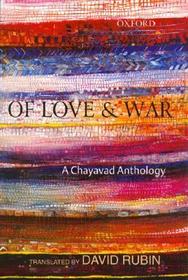
Of Love and War
A Chayavad Anthology
- Publisher's listprice GBP 9.99
-
4 510 Ft (4 295 Ft + 5% VAT)
The price is estimated because at the time of ordering we do not know what conversion rates will apply to HUF / product currency when the book arrives. In case HUF is weaker, the price increases slightly, in case HUF is stronger, the price goes lower slightly.
- Discount 10% (cc. 451 Ft off)
- Discounted price 4 059 Ft (3 866 Ft + 5% VAT)
Subcribe now and take benefit of a favourable price.
Subscribe
4 510 Ft

Availability
Out of print
Why don't you give exact delivery time?
Delivery time is estimated on our previous experiences. We give estimations only, because we order from outside Hungary, and the delivery time mainly depends on how quickly the publisher supplies the book. Faster or slower deliveries both happen, but we do our best to supply as quickly as possible.
Product details:
- Publisher Oxford University Press
- Date of Publication 24 November 2005
- ISBN 9780195675320
- Binding Hardback
- No. of pages144 pages
- Size 215x140x13 mm
- Weight 341 g
- Language English 0
Categories
Short description:
This is an anthology of the works of four leading Hindi poets, in translation, of the genre and period (roughly between the two world wars) known as Chayavad. This volume comes with a critical introduction by David Rubin who contextualizes this literary movement within the larger socio-political movement of the time.
MoreLong description:
Until late in the 19th century, Hindi literary works were predominantly in Braj, spoken mainly around Agra and Mathura. The other form of Hindi, khari boli (spoken around Delhi and Meerut), was viewed as too unrefined for the expression of poetic sentiments and images. Though the earliest works in khari boli were prosaic with a strong element of the moralizing and didactic, it subsequently evolved into a more interesting literature, in the period between the two World Wars, typified
by the poetry known as Chayavad.
Like the Romantic tendencies in the West, Chayavad was marked with elements of symbolism and mysticism. Upanisadic teachings, the English Romantic poets, the French Symbolists, Tagore, Sanskrit aesthetics, all seemed to have influenced this genre. The four principal Chayavad poets Jayshankar Prasad, Suryakant Tripathi ‘ Nirala’, Sumitranandan Pant, and Mahadevi Varma created a poetry in which khari boli Hindi attained an incontestable brilliance a nd
elegance of expression.
The most striking element in Chayavad is its subjectivity. These poets, even when returning to subjects derived from the epics and Puranas, would mark them with reference to his own history and outlook. They all frequently resort to natural phenomena or (with the exception to Mahadevi) to historical events as vehicles for autobiography. Like the Western Romantic poets, the Chayavadis gave nature a pre-eminent place in their work and sought fresh new ways of envisioning the natural world. Erotic
themes, both in metaphor and explicit statement, represented another new development in Chayavad poetry.
Prasad (1889-1937), the first Chayavad poet to attain fame, was the most eloquent of those who saw the need for a new direction in Hindi poetry and free it from the traditions and conventions considered sacrosanct. His works include novels, essays, short stories, and a series of dramas. Nirala’s (1899-1961) oeuvre includes novels, short stories, and es says apart from, of course, poetry. He experiments boldly with free verse and innovative re-creations of epic subjects and devotional
themes. His novels and stories were satirical attacks on the hypocrisy of and oppression by the upper castes. Pant (1902-87) is best known for his romantic poetry celebrating love and nature. His works reflect his concern for the social conditions of his time, for the downtrodden and the poor. Varma
(1902-87) is a major figure in the renaissance of Hindi literature and considered its finest woman poet. Unlike her contemporary Chayavad poets, her work is almost completely removed from every-day life. She created a series of highly refined, complex, and often obscure, lyrics between 1930 and 1942.
Table of Contents:
Preface
Note on Transliteration
Introduction
Part One: Jayshankar Prasad
Suryakant Tripathi
Nirala
Part Two: Jayshankar Prasad
Suryakant Tripathi
Nirala
Sumitranandan Pant
Mahadevi Varma
Selected Bibliography

