

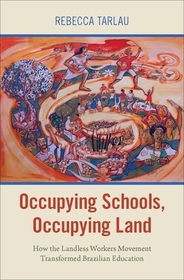
Occupying Schools, Occupying Land
How the Landless Workers' Movement Transformed Brazilian Education
Series: Global and Comparative Ethnography;
- Publisher's listprice GBP 61.00
-
27 541 Ft (26 230 Ft + 5% VAT)
The price is estimated because at the time of ordering we do not know what conversion rates will apply to HUF / product currency when the book arrives. In case HUF is weaker, the price increases slightly, in case HUF is stronger, the price goes lower slightly.
- Discount 10% (cc. 2 754 Ft off)
- Discounted price 24 787 Ft (23 607 Ft + 5% VAT)
Subcribe now and take benefit of a favourable price.
Subscribe
27 541 Ft

Availability
printed on demand
Why don't you give exact delivery time?
Delivery time is estimated on our previous experiences. We give estimations only, because we order from outside Hungary, and the delivery time mainly depends on how quickly the publisher supplies the book. Faster or slower deliveries both happen, but we do our best to supply as quickly as possible.
Product details:
- Publisher OUP USA
- Date of Publication 20 June 2019
- ISBN 9780190870324
- Binding Hardback
- No. of pages416 pages
- Size 157x236x38 mm
- Weight 703 g
- Language English
- Illustrations 14 line drawings; 17 half tones 0
Categories
Short description:
In Occupying Schools, Occupying Land, Rebecca Tarlau looks at the Brazilian Landless Workers' Movement over the past thirty-five years to illustrate how social movements can use state services, such as schools, to support their social change goals. Through a detailed ethnographic and long-term examination of the MST's educational struggle, Tarlau shows how educational institutions can in turn help movements build capacity and social influence. This book provides an analysis of how activists convinced government officials to implement these educational practices and how these initiatives strengthened the movement.
MoreLong description:
Over the past thirty-five years the Brazilian Landless Workers Movement (MST), one of the largest social movements in Latin America, has become famous globally for its success in occupying land, winning land rights, and developing alternative economic enterprises for over a million landless workers. The movement has also linked education reform to its vision for agrarian reform by developing pedagogical practices for schools that foster activism, direct democracy, and collective forms of work.
In Occupying Schools, Occupying Land, Rebecca Tarlau explores how MST activists have pressured municipalities, states, and the federal government to implement their educational program in public schools and universities, affecting hundreds of thousands of students. Contrary to the belief that movements cannot engage the state without demobilizing, Tarlau shows how educational institutions can help movements recruit new activists, diversify their membership, increase technical knowledge, and garner political power. Drawing on twenty months of ethnographic field work, Tarlau documents how the MST operates in different regions working at times with or through the state, at other times outside it and despite it. She argues that activists are most effective using contentious co-governance, combining disruption and public protest with institutional pressure to defend and further their goals.
Through an examination of the potentials, constraints, failures, and contradictions of the MST's educational struggle, Occupying Schools, Occupying Land offers insights into the relationship between education and social change, social movements and states, and the barriers and possibilities for similar reforms in democratic contexts throughout the world.
This is a brilliant book by a brilliant young scholar. It is one of the finest studies available on the Brazilian Landless Movement (the MST), perfectly balancing rigorous comparative institutional analysis with an activist's appreciation for social justice and an ethnographer's attention to detail. Tarlau captures nicely the complexity of the political landscape in Brazil, and she makes a compelling argument for the underappreciated role that education can play in institutionalizing social mobilization
Table of Contents:
Acknowledgments
List of Acronyms
List of Illustrations
Introduction
Part One: Constructing a National Educational Program
1. Pedagogical Experiments in the Brazilian Countryside
2. Transforming Universities to Build a Movement: The Case of PRONERA
3. From the Pedagogy of the MST to Educação do Campo: Expansion, Transformation, and Compromise
Part Two: Regional Cases of Contentious Co-Governance of Public Education
4. Rio Grande do Sul: Political Regimes and Social Movement Co-Governance
5. Pernambuco: Patronage, Leadership, and Educational Change
6. Ceará: The Influence of National Advocacy on Regional Trajectories
Conclusion
Epilogue
Appendix A: Manifesto of Educators of Agrarian Reform, July 1997
Appendix B: Curriculum of the University of Ijuí Pedagogy of Land Program (1998-2001)
Appendix C: Curriculum of the UNESP PRONERA Geography Program (2007-2011)
Appendix D: Fourth National Seminar on PRONERA Final Document, November 2010
Appendix E: Manifesto of Educators of Agrarian Reform, September 2015
Glossary of Portuguese Terms
Notes
References
Index

