

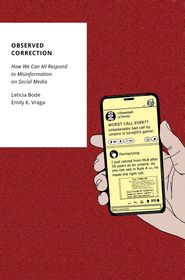
Observed Correction
How We Can All Respond to Misinformation on Social Media
Series: Oxford Studies in Digital Politics;
- Publisher's listprice GBP 18.99
-
8 573 Ft (8 165 Ft + 5% VAT)
The price is estimated because at the time of ordering we do not know what conversion rates will apply to HUF / product currency when the book arrives. In case HUF is weaker, the price increases slightly, in case HUF is stronger, the price goes lower slightly.
- Discount 10% (cc. 857 Ft off)
- Discounted price 7 716 Ft (7 349 Ft + 5% VAT)
Subcribe now and take benefit of a favourable price.
Subscribe
8 573 Ft

Availability
Estimated delivery time: In stock at the publisher, but not at Prospero's office. Delivery time approx. 3-5 weeks.
Not in stock at Prospero.
Why don't you give exact delivery time?
Delivery time is estimated on our previous experiences. We give estimations only, because we order from outside Hungary, and the delivery time mainly depends on how quickly the publisher supplies the book. Faster or slower deliveries both happen, but we do our best to supply as quickly as possible.
Product details:
- Publisher OUP USA
- Date of Publication 30 September 2025
- ISBN 9780197565902
- Binding Paperback
- No. of pages254 pages
- Size 229x157x25 mm
- Weight 318 g
- Language English 642
Categories
Short description:
In Observed Correction, Leticia Bode and Emily K. Vraga consider both the power of and the barriers to "observed correction"--users witnessing other users correct misinformation on social media. Bode and Vraga argue that when people view others directly and publicly correcting misinformation on social media, their understanding of the topic becomes more accurate. Drawing on experiments, surveys, and interviews with social media users, health professionals, fact checkers, and platform employees, Bode and Vraga offer a set of practical recommendations for how observational correction can be implemented.
MoreLong description:
While many solutions have been proposed to combat misinformation on social media, most are either ineffective, expensive, or do not work at scale. What if social media users could help mitigate the misinformation they're also responsible for proliferating?
In Observed Correction, Leticia Bode and Emily K. Vraga consider both the power of and the barriers to "observed correction"--users witnessing other users correct misinformation on social media. Bode and Vraga argue that when people view others directly and publicly correct misinformation on social media, their understanding of the topic becomes more accurate. Yet, while many members of the public value correction, Bode and Vraga find that they are often reluctant to correct misinformation they see on social media. This same reluctance to correct is seen among expert fact checkers and health communicators, compounded by the constraints of limited resources and competing priorities. To empower people to respond to misinformation, Bode and Vraga offer a set of practical recommendations for how observational correction can be implemented. In some cases, simple messages addressing concerns can increase users' willingness to respond to misinformation. In other cases, they argue that platforms will need to promote corrections and protect the correctors while experts can contribute by creating accessible curated evidence (ACE) to facilitate user corrections and build social norms around responding to misinformation.
Including analysis of eleven experiments, seven surveys, and dozens of interviews with social media users, health professionals, fact checkers, and platform employees about their efforts to curb misinformation online, Bode and Vraga make the case that observed correction is an effective and scalable tool in the fight against bad content on the Internet.
Table of Contents:
Chapter 1: Introduction
Chapter 2: The Theory of Observed Correction
Chapter 3: Observed Correction Increases Accuracy
Chapter 4: Correction Recall
Chapter 5: Perception of Correction
Chapter 6: Conflicted Correctors
Chapter 7: Motivating Correction
Chapter 8: Constrained Experts
Chapter 9: Accessible Curated Evidence
Chapter 10: Conclusions
Notes
References
Index

