

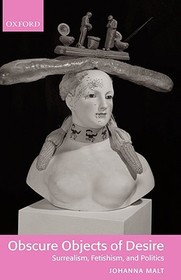
Obscure Objects of Desire - Surrealism, Fetishism, and Politics
Surrealism, Fetishism, and Politics
- Publisher's listprice GBP 180.00
-
85 995 Ft (81 900 Ft + 5% VAT)
The price is estimated because at the time of ordering we do not know what conversion rates will apply to HUF / product currency when the book arrives. In case HUF is weaker, the price increases slightly, in case HUF is stronger, the price goes lower slightly.
- Discount 10% (cc. 8 600 Ft off)
- Discounted price 77 396 Ft (73 710 Ft + 5% VAT)
Subcribe now and take benefit of a favourable price.
Subscribe
85 995 Ft

Availability
printed on demand
Why don't you give exact delivery time?
Delivery time is estimated on our previous experiences. We give estimations only, because we order from outside Hungary, and the delivery time mainly depends on how quickly the publisher supplies the book. Faster or slower deliveries both happen, but we do our best to supply as quickly as possible.
Product details:
- Publisher OUP Oxford
- Date of Publication 22 January 2004
- ISBN 9780199253425
- Binding Hardback
- No. of pages248 pages
- Size 224x145x17 mm
- Weight 469 g
- Language English
- Illustrations 7 halftones 0
Categories
Short description:
This book offers a new critical approach to the political claims of the surrealist movement, asking whether it is possible to theorize a connection between the surrealists' commitment to the cause of revolutionary socialism, and the form that surrealist art and writing took. Through the analysis of narratives, paintings and objets surréalistes by Breton, Aragon, Dalí, and others, Malt examines how the object emerges as psychologically and historically marked in the surrealist context, functioning as both fetish and fetishized commodity. Responding to recent debates about the role of the uncanny and the representation of the body in surrealist art and literature, Malt's study offers new perspectives on familiar works such as the paintings of Salvador Dalì as well as illuminating relatively neglected ones such as Breton's poèmes-objets.
MoreLong description:
In a speech given in Prague in 1935, André Breton asked, 'Is there, properly speaking, a left-wing art capable of defending itself?'. But despite his conviction that surrealism did indeed offer such an art, Breton always struggled to make a theoretical connection between the surrealists' commitment to the cause of revolutionary socialism and the form that surrealist art and literature took. Obscure Objects of Desire explores ways in which such a connection might be drawn, addressing the possibility of surrealist works as political in themselves and drawing on ways in which they have been considered as such by Marxists such as Benjamin and Adorno and by recent cultural critics. Encompassing Breton's and Aragon's textual accounts of the object, as well as paintings and the various kinds of objet surréaliste produced from the end of the 1920s, Malt mobilises the concept of the fetish in order to consider such works as meeting points of surrealism's psychoanalytic and revolutionary preoccupations.
Reading surrealist works of art and literature as political is by no means the same thing as knowing the surrealist movement to have been a politically motivated one. The revolutionary character of the surrealist work itself, in isolation from the polemical positions taken up by Breton and others on its behalf, is not always evident; indeed, the works themselves often seem to express a rather different set of concerns. As well as offering a new perspective on familiar works such as the paintings of Salvador Dalí, and relatively neglected ones like Breton's poèmes-objets, this book recuperates the gap between theory and practice as a productive space in which it is possible to recontextualize surrealist practice as an engagement with political questions on its own terms.
Malt's Obscure Objects of Desire offers a valuable synthesis of literary and art-historical analytical approaches to the study of surrealism, as well as a complex picture of the idealogical structures the surrealists both confronted and fetishized.
Table of Contents:
Introduction
Subjectivity and Revolutionary Commitment
Archaeology and Mythology: Benjamin and Le paysan de Paris
The Surrealist Object in Theory
The Surrealist Object as Fetish
Poetry in the Object World
Windows: Painting and the Fetish Surface
Conclusion
Bibliography
Index

