

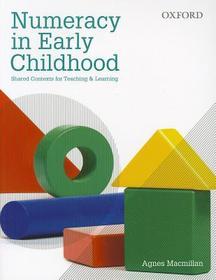
Numeracy in Early Childhood
Shared Contexts for Teaching and Learning
- Publisher's listprice GBP 48.99
-
22 118 Ft (21 065 Ft + 5% VAT)
The price is estimated because at the time of ordering we do not know what conversion rates will apply to HUF / product currency when the book arrives. In case HUF is weaker, the price increases slightly, in case HUF is stronger, the price goes lower slightly.
- Discount 10% (cc. 2 212 Ft off)
- Discounted price 19 906 Ft (18 959 Ft + 5% VAT)
Subcribe now and take benefit of a favourable price.
Subscribe
22 118 Ft

Availability
Out of print
Why don't you give exact delivery time?
Delivery time is estimated on our previous experiences. We give estimations only, because we order from outside Hungary, and the delivery time mainly depends on how quickly the publisher supplies the book. Faster or slower deliveries both happen, but we do our best to supply as quickly as possible.
Product details:
- Publisher OUP Australia & New Zealand
- Date of Publication 10 September 2009
- ISBN 9780195567021
- Binding Paperback
- No. of pages288 pages
- Size 246x190x16 mm
- Weight 560 g
- Language English
- Illustrations 80 illustrations and photos 0
Categories
Short description:
Numeracy in Early Childhood: Shared Contexts for Teaching and Learning is covers all the topics which are important for those studying to become early childhood practitioners. This Australian text focuses on using everyday language and objects to teach numeracy skills to young children.
MoreLong description:
This book demonstrates how early childhood practitioners can stimulate and facilitate numeracy education from infancy by listening, observing and responding to the mathematical content in children's in everyday life. Detailed observations of real life situations and dialogue assist pre-service teachers to make sense of mathematical meanings and teaching strategies. With reference to the Australian Association of Mathematics Teachers' Standards of Excellence, current
early education teaching models and planning and assessment practices are examined. Mathematical concepts are simply explained to assist the readers' own conceptual knowledge, so that they can recognise the mathematics and support children in their numeracy development. The underlying theories and
current research into children's learning is used to examine children's acquisition of numerate identities.
Table of Contents:
List of Figures
List of Tables
Acknowledgments
Introduction
Shared Contexts for Teaching and Learning Numeracy
Children Becoming Numerate
The role of language in learning
Managing the resources of the community
The acquisition of a numerate identity
Professional Knowledge
Using the Language of Mathematics
Assessing children's mathematical learning potential
Approaches to planning in numeracy education
Catering for individual learning potential and cultural diversity
Ben's acquisition of a numerate identity at school
Glossary
Appendices
Index

