

- Publisher's listprice GBP 10.99
-
5 250 Ft (5 000 Ft + 5% VAT)
The price is estimated because at the time of ordering we do not know what conversion rates will apply to HUF / product currency when the book arrives. In case HUF is weaker, the price increases slightly, in case HUF is stronger, the price goes lower slightly.
- Discount 10% (cc. 525 Ft off)
- Discounted price 4 725 Ft (4 500 Ft + 5% VAT)
Subcribe now and take benefit of a favourable price.
Subscribe
5 250 Ft

Availability
printed on demand
Why don't you give exact delivery time?
Delivery time is estimated on our previous experiences. We give estimations only, because we order from outside Hungary, and the delivery time mainly depends on how quickly the publisher supplies the book. Faster or slower deliveries both happen, but we do our best to supply as quickly as possible.
Product details:
- Publisher OUP USA
- Date of Publication 11 August 2011
- ISBN 9780199759460
- Binding Paperback
- No. of pages240 pages
- Size 206x137x20 mm
- Weight 249 g
- Language English 0
Categories
Short description:
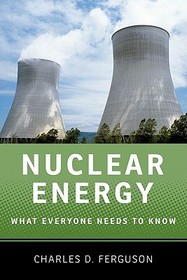
In this accessible overview, Charles D. Ferguson provides an authoritative account of the key facts about nuclear energy. What is the origin of nuclear energy? What countries use commercial nuclear power, and how much electricity do they obtain from it? How can future nuclear power plants be made safer? What can countries do to protect their nuclear facilities from military attacks? How hazardous is radioactive waste? Is nuclear energy a renewable energy source? Ferguson addresses these questions and more in a book that is essential for anyone looking to learn more about this important issue.
MoreLong description:
Originally perceived as a cheap and plentiful source of power, the commercial use of nuclear energy has been controversial for decades. Worries about the dangers that nuclear plants and their radioactive waste posed to nearby communities grew over time, and plant construction in the United States virtually died after the early 1980s. The 1986 disaster at Chernobyl only reinforced nuclear power's negative image. Recent years have seen a marked change, however. The alarming acceleration of global warming due to the burning of fossil fuels and concern about dependence on foreign fuel has led policymakers, climate scientists, and energy experts to look once again at nuclear power as a source of energy.
In this accessible overview, Charles D. Ferguson provides an authoritative account of the key facts about nuclear energy. What is the origin of nuclear energy? What countries use commercial nuclear power, and how much electricity do they obtain from it? How can future nuclear power plants be made safer? What can countries do to protect their nuclear facilities from military attacks? How hazardous is radioactive waste? Is nuclear energy a renewable energy source? Ferguson addresses these questions and more in a book that is essential for anyone looking to learn more about this important issue.
An accessible text with a strong structure that provides a launch pad for further exploration.
Table of Contents:
Contents
Preface
Acknowledgements
1. Fundamentals
What is energy, and what is power?
Is most energy that people use derived from nuclear energy?
What is the origin of nuclear energy?
What is radioactivity?
Why is ionizing radiation a health concern?
What is radioactive half-life, and how can knowing it help increase countries' security?
How much more energetic is nuclear energy compared to chemical energy?
Why has it been so difficult to commercialize nuclear fusion?
How was nuclear fission discovered?
What role, if any, did Albert Einstein play in the discovery of nuclear energy?
What is a fission chain reaction?
What is uranium, where did it come from, and how was it discovered?
What is plutonium, how was it discovered, and how hazardous is it?
Why can't nuclear reactors explode like a nuclear bomb?
What is the nuclear fuel cycle?
Why are certain activities in the nuclear fuel cycle called "dual-use "?
What are the various uranium enrichment methods?
What are the nuclear

