

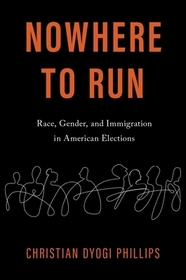
Nowhere to Run
Race, Gender, and Immigration in American Elections
- Publisher's listprice GBP 98.00
-
44 247 Ft (42 140 Ft + 5% VAT)
The price is estimated because at the time of ordering we do not know what conversion rates will apply to HUF / product currency when the book arrives. In case HUF is weaker, the price increases slightly, in case HUF is stronger, the price goes lower slightly.
- Discount 10% (cc. 4 425 Ft off)
- Discounted price 39 822 Ft (37 926 Ft + 5% VAT)
Subcribe now and take benefit of a favourable price.
Subscribe
44 247 Ft

Availability
Estimated delivery time: In stock at the publisher, but not at Prospero's office. Delivery time approx. 3-5 weeks.
Not in stock at Prospero.
Why don't you give exact delivery time?
Delivery time is estimated on our previous experiences. We give estimations only, because we order from outside Hungary, and the delivery time mainly depends on how quickly the publisher supplies the book. Faster or slower deliveries both happen, but we do our best to supply as quickly as possible.
Product details:
- Publisher OUP USA
- Date of Publication 12 October 2021
- ISBN 9780197538937
- Binding Hardback
- No. of pages278 pages
- Size 159x241x20 mm
- Weight 526 g
- Language English 128
Categories
Short description:
Nowhere to Run introduces the intersectional model of electoral opportunity, which argues that descriptive representation in elections is shaped by intersecting processes related to race and gender. Drawing on an original dataset encompassing nearly every state legislative general election from 1996-2015, as well as interviews and surveys with candidates, donors, and other political elites from 42 states, the book tests this theory with a first of its kind study of Asian American and Latina/o candidacies, and the first simultaneous look at the relationship between changing populations and descriptive representation for African American, Asian American, Latina/o, and white women and men.
MoreLong description:
Why has the underrepresentation of women and racial minorities in elected office proved so persistent? Many researchers have asserted that the main shortfall happens at the candidacy stage--women and people of color are competitive candidates, but too few throw their hat into the ring. However, these studies are animated by two assumptions that tend to speak past each other. On the one hand, gender and politics scholars often suggest that women lack sufficient ambition to run for office relative to men. On the other hand, race and politics scholars have suggested that districts with majority white populations do not provide adequate resources or opportunities for minority candidates to succeed. These approaches tend to treat women and racial minorities as parallel social groups, and fail to account for the ways in which race and gender simultaneously shape candidacy.
Nowhere to Run introduces the intersectional model of electoral opportunity, which argues that descriptive representation in elections is shaped by intersecting processes related to race and gender. Across states, realistic opportunities for potential candidates of color to get on state legislative ballots are sharply circumscribed by the distribution of white majority populations in most districts; and within the districts that are most widely viewed as winnable seats--majority minority districts--the perceived scarcity of viable electoral opportunities exacerbates factors that tend to push women of color farther from the candidate pipeline. These overlapping constraints result in an electoral landscape where women of color face constraints on electoral opportunity that are intersecting and multilayered.
Drawing on an original dataset encompassing nearly every state legislative general election from 1996-2015, as well as interviews and surveys with candidates, donors, and other political elites from 42 states, Nowhere to Run tests this theory with a first of its kind study of Asian American and Latina/o candidacies, and the first simultaneous look at the relationship between changing populations and descriptive representation for African American, Asian American, Latina/o, and white women and men. The book sheds new light on how multiple dimensions of identity simultaneously shape pathways to candidacy and representation for all groups seeking a seat at the table in American politics.
Table of Contents:
Acknowledgments
Chapter 1: Introduction
Chapter 2: Empirical Strategies for Intersectional Research
Chapter 3: Candidacy in Contexts
Chapter 4: Demographics are (Men's) Destiny
Chapter 5: The Rest of the Pie: Partisanship and Race-Gendered Opportunities in Predominantly White Districts
Chapter 6: If Not Here, Then Where?: Constrained Opportunities for Immigrant Representation in Los Angeles County
Chapter 7: "She came out of nowhere": Elite Networks and Candidate Emergence in Los Angeles
Chapter 8: The Future of Candidacy and Representation in American State Legislatures
Appendices
Notes
References

