

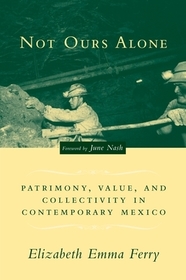
Not Ours Alone
Patrimony, Value, and Collectivity in Contemporary Mexico
- Publisher's listprice GBP 32.00
-
15 288 Ft (14 560 Ft + 5% VAT)
The price is estimated because at the time of ordering we do not know what conversion rates will apply to HUF / product currency when the book arrives. In case HUF is weaker, the price increases slightly, in case HUF is stronger, the price goes lower slightly.
- Discount 10% (cc. 1 529 Ft off)
- Discounted price 13 759 Ft (13 104 Ft + 5% VAT)
Subcribe now and take benefit of a favourable price.
Subscribe
15 288 Ft

Availability
Estimated delivery time: Expected time of arrival: end of January 2026.
Not in stock at Prospero.
Why don't you give exact delivery time?
Delivery time is estimated on our previous experiences. We give estimations only, because we order from outside Hungary, and the delivery time mainly depends on how quickly the publisher supplies the book. Faster or slower deliveries both happen, but we do our best to supply as quickly as possible.
Product details:
- Publisher Columbia University Press
- Date of Publication 3 March 2006
- ISBN 9780231132398
- Binding Paperback
- No. of pages296 pages
- Size 205 x 165 mm
- Language English 0
Categories
Short description:
Elizabeth Ferry explores how members of the Santa Fe Cooperative, a silver mine in Mexico, give meaning to their labor in an era of rampant globalization. She analyzes the cooperative's practices and the importance of patrimonio (patrimony) in their understanding of work, tradition, and community. More specifically, she argues that patrimonio, a belief that certain resources are inalienable possessions of a local collective passed down to subsequent generations, has shaped and sustained the cooperative's sense of identity.
MoreLong description:
Elizabeth Ferry explores how members of the Santa Fe Cooperative, a silver mine in Mexico, give meaning to their labor in an era of rampant globalization. She analyzes the cooperative's practices and the importance of patrimonio (patrimony) in their understanding of work, tradition, and community. More specifically, she argues that patrimonio, a belief that certain resources are inalienable possessions of a local collective passed down to subsequent generations, has shaped and sustained the cooperative's sense of identity.
More
