

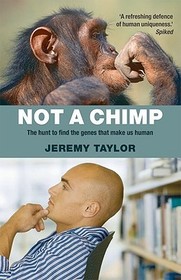
Not a Chimp
The hunt to find the genes that make us human
- Publisher's listprice GBP 8.99
-
4 058 Ft (3 865 Ft + 5% VAT)
The price is estimated because at the time of ordering we do not know what conversion rates will apply to HUF / product currency when the book arrives. In case HUF is weaker, the price increases slightly, in case HUF is stronger, the price goes lower slightly.
- Discount 10% (cc. 406 Ft off)
- Discounted price 3 652 Ft (3 479 Ft + 5% VAT)
Subcribe now and take benefit of a favourable price.
Subscribe
4 058 Ft

Availability
Uncertain availability. Please turn to our customer service.
Why don't you give exact delivery time?
Delivery time is estimated on our previous experiences. We give estimations only, because we order from outside Hungary, and the delivery time mainly depends on how quickly the publisher supplies the book. Faster or slower deliveries both happen, but we do our best to supply as quickly as possible.
Product details:
- Publisher OUP Oxford
- Date of Publication 27 May 2010
- ISBN 9780199227792
- Binding Paperback
- No. of pages368 pages
- Size 196x129x21 mm
- Weight 273 g
- Language English
- Illustrations 22 black and white photographs and line drawings 0
Categories
Short description:
Are chimps almost human? Are we just smarter chimps? What does that oft-quoted 1.6% difference in DNA actually mean? As teams worldwide seek the genetic basis of our humanity, a complex picture is emerging. Small changes in key genes can cause big ones in brains, bodies and behaviour. We've changed profoundly since the chimp-human split.
MoreLong description:
Humans are primates, and our closest relatives are the other African apes - chimpanzees closest of all. With the mapping of the human genome, and that of the chimp, a direct comparison of the differences between the two, letter by letter along the billions of As, Gs, Cs, and Ts of the DNA code, has led to the widely vaunted claim that we differ from chimps by a mere 1.6% of our genetic code. A mere hair's breadth genetically! To a rather older tradition of anthropomorphizing chimps,
trying to get them to speak, dressing them up for 'tea parties', was added the stamp of genetic confirmation. It also began an international race to find that handful of genes that make up the difference - the genes that make us uniquely human.
But what does that 1.6% really mean? And should it really lead us to consider extending limited human rights to chimps, as some have suggested? Are we, after all, just chimps with a few genetic tweaks? Is our language and our technology just an extension of the grunts and ant-collecting sticks of chimps? In this book, Jeremy Taylor sketches the picture that is emerging from cutting edge research in genetics, animal behaviour, and other fields. The indications are that the so-called 1.6% is much
larger and leads to profound differences between the two species. We shared a common ancestor with chimps some 6-7 million years ago, but we humans have been racing away ever since. One in ten of our genes, says Taylor, has undergone evolution in the past 40,000 years! Some of the changes that
happened since we split from chimpanzees are to genes that control the way whole orchestras of other genes are switched on and off, and where. Taylor shows, using studies of certain genes now associated with speech and with brain development and activity, that the story looks to be much more complicated than we first thought. This rapidly changing and exciting field has recently discovered a host of genetic mechanisms that make us different from other apes.
As Taylor points out, for too long we have let our sentimentality for chimps get in the way of our understanding. Chimps use tools, but so do crows. Certainly chimps are our closest genetic relatives. But relatively small differences in genetic code can lead to profound differences in cognition and behaviour. Our abilities give us the responsibility to protect and preserve the natural world, including endangered primates. But for the purposes of human society and human concepts such as rights,
let's not pretend that chimps are humans uneducated and undressed. We've changed a lot in those 12 million years.
A Library Journal Sci-Tech Book of the Year, 2010
Table of Contents:
Introduction
The language gene that wasn't
Brain-builders
The riddle of the 1.6%
Less-is-more
More is better
Pandora's box
Povinelli's gauntlet
Clever corvids
Inside the brain - the devil is in the detail
Playing with madness
The ape that domesticated itself

