

- Publisher's listprice GBP 115.00
-
54 941 Ft (52 325 Ft + 5% VAT)
The price is estimated because at the time of ordering we do not know what conversion rates will apply to HUF / product currency when the book arrives. In case HUF is weaker, the price increases slightly, in case HUF is stronger, the price goes lower slightly.
- Discount 10% (cc. 5 494 Ft off)
- Discounted price 49 447 Ft (47 093 Ft + 5% VAT)
Subcribe now and take benefit of a favourable price.
Subscribe
54 941 Ft

Availability
printed on demand
Why don't you give exact delivery time?
Delivery time is estimated on our previous experiences. We give estimations only, because we order from outside Hungary, and the delivery time mainly depends on how quickly the publisher supplies the book. Faster or slower deliveries both happen, but we do our best to supply as quickly as possible.
Product details:
- Publisher Clarendon Press
- Date of Publication 24 September 1992
- ISBN 9780198257196
- Binding Hardback
- No. of pages368 pages
- Size 219x145x26 mm
- Weight 588 g
- Language English 0
Categories
Short description:
A study of the conflict in legal philosophy between positivistic and anti-positivistic theories of law with respect to seven issues in legal philosophy - law as a reason for action, law and authority, the internal point of view to law, the acceptance of law, discretion and principle, interpretation and semantics, and law and the common good.
MoreLong description:
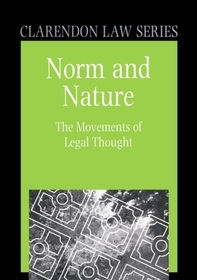
Norm and Nature deals with the traditional conflict in legal philosophy between positivistic and anti-positivistic theories of law. It examines the conflict with respect to seven central issues in legal philosophy - law as a reason for action, law and authority, the internal point of view to law, the acceptance of law, discretion and principle, interpretation and semantics, and law and the common good.
It has three theses. First, that the opposition to positivism is based on acceptance of, rather than rejection of, claims made by positivism. Secondly, that the conflict between positivism and anti-positivism is irresolvable and finally, that the understanding of why this is so is the key to the understanding of the nature of law. Tension between formal and substantive considerations comprises the essence of law. The central theses presuppose that anti-positivism or natural law theory is defensible as an account of the nature of law. More than half the book, therefore, is a criticism of the prevailing orthodoxy of legal positivism and a defence of an anti-positivist view, making Norm and Nature important not only for the originality of its central theses, but also for its critique of positivism and for the thoroughness of its examination of contemporary legal thought.
`For a brilliant presentation and appraisal of all moves in this debate, and of the underlying movements in thought, look no further than Roger Shiner's Norm and Nature, a quite splendid book ... scholarly acumen, practical insight, lucid style, and pointed wit.'
Neil MacCormick, Times Literary Supplement

