

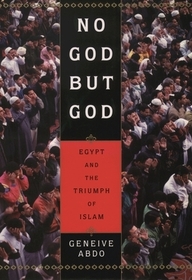
No God but God
Egypt and the Triumph of Islam
- Publisher's listprice GBP 17.49
-
8 355 Ft (7 957 Ft + 5% VAT)
The price is estimated because at the time of ordering we do not know what conversion rates will apply to HUF / product currency when the book arrives. In case HUF is weaker, the price increases slightly, in case HUF is stronger, the price goes lower slightly.
- Discount 10% (cc. 836 Ft off)
- Discounted price 7 519 Ft (7 161 Ft + 5% VAT)
Subcribe now and take benefit of a favourable price.
Subscribe
8 355 Ft

Availability
printed on demand
Why don't you give exact delivery time?
Delivery time is estimated on our previous experiences. We give estimations only, because we order from outside Hungary, and the delivery time mainly depends on how quickly the publisher supplies the book. Faster or slower deliveries both happen, but we do our best to supply as quickly as possible.
Product details:
- Publisher OUP USA
- Date of Publication 9 November 2004
- ISBN 9780195157932
- Binding Paperback
- No. of pages240 pages
- Size 234x149x15 mm
- Weight 367 g
- Language English 0
Categories
Long description:
Western media has consistently focused on the extremes of Islam, overlooking a quiet yet pervasive moderate religious movement that is currently transforming the nation of Egypt. Drawing on hundreds of interviews, No God But God opens up previously inaccessible segments of Egyptian society to illustrate the deep penetration of "Popular Islamic" influence. Geneive Abdo provides a firsthand account of this movement, allowing its leaders, street preachers, scholars, doctors, lawyers, men and women of all social classes to speak for themselves. Challenging Western stereotypes, she finds that this growing number of Islamists do not seek the violent overthrow of the government or a return to a medieval age. Instead, they believe their religious values are compatible with the demands of the modern world. They are working within and beyond the secular framework of the nation to gradually create a new society based on Islamic principles.
Both fascinating and unsettling, Abdo's findings identify a grassroots model for transforming a secular nation-state to an Islamic social order that will likely inspire other Muslim nations.
As Abdo effectively points out in this important work, regardless of significant Western cultural influence and a relatively secular and firm Egyptian government, the grassroots Islamic revival taking shape in Egypt is indeed a serious and thriving force.

