

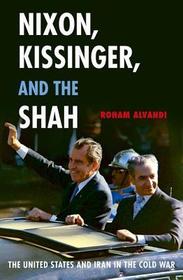
Nixon, Kissinger, and the Shah
The United States and Iran in the Cold War
- Publisher's listprice GBP 34.49
-
16 477 Ft (15 692 Ft + 5% VAT)
The price is estimated because at the time of ordering we do not know what conversion rates will apply to HUF / product currency when the book arrives. In case HUF is weaker, the price increases slightly, in case HUF is stronger, the price goes lower slightly.
- Discount 10% (cc. 1 648 Ft off)
- Discounted price 14 829 Ft (14 123 Ft + 5% VAT)
Subcribe now and take benefit of a favourable price.
Subscribe
16 477 Ft

Availability
printed on demand
Why don't you give exact delivery time?
Delivery time is estimated on our previous experiences. We give estimations only, because we order from outside Hungary, and the delivery time mainly depends on how quickly the publisher supplies the book. Faster or slower deliveries both happen, but we do our best to supply as quickly as possible.
Product details:
- Publisher OUP USA
- Date of Publication 8 December 2016
- ISBN 9780190610685
- Binding Paperback
- No. of pages272 pages
- Size 231x155x15 mm
- Weight 386 g
- Language English
- Illustrations 12 illus. 0
Categories
Short description:
In this revisionist account of U.S.-Iran relations during the Cold War, Roham Alvandi provides a detailed historical study of the partnership that Shah Mohammad Reza Pahlavi of Iran forged with U.S. President Richard Nixon and his adviser Henry Kissinger in the 1970s.
MoreLong description:
Mohammad Reza Pahlavi, the last shah of Iran, is often remembered as a pliant instrument of American power during the Cold War. In this groundbreaking study Roham Alvandi offers a revisionist account of the shah's relationship with the United States by examining the partnership he forged with Richard Nixon and Henry Kissinger in the 1970s. Based on extensive research in the British and U.S. archives, as well as a wealth of Persian-language diaries, memoirs, and oral histories, this work restores agency to the shah as an autonomous international actor and suggests that Iran evolved from a client to a partner of the United States under the Nixon Doctrine.
Nixon, Kissinger, and the Shah offers a detailed account of three key historical episodes in the Nixon-Kissinger-Pahlavi partnership that shaped the global Cold War far beyond Iran's borders. It examines the emergence of Iranian primacy in the Persian Gulf as the Nixon administration looked to the shah to fill the vacuum created by the British withdrawal from the region in 1971. It then turns to the peak of the partnership after Nixon and Kissinger's historic 1972 visit to Iran, when the shah succeeded in drawing the United States into his covert war against Iraq in Kurdistan. Finally, it focuses on the decline of the partnership under Nixon's successor, Gerald Ford, through a history of the failed negotiations from 1974 to 1976 for an agreement on U.S. nuclear exports to Iran. Taken together, these episodes map the rise of the fall of Iran's Cold War partnership with the United States during the decade of superpower détente, Vietnam, and Watergate.
This work of American diplomatic history, international relations, and Middle Eastern Studies provides critical historic background on Iran's ambitions for primacy in the Persian Gulf, its nuclear program, and what a US-Iran strategic partnership might look like in the future.
In Nixon, Kissinger, and the Shah Roham Alvandi examines the intimate relationship that developed among three 1970s cold warriors: President Richard M. Nixon, Henry Kissinger, and Iranian shah Mohammad Reza Pahlavi.... [Alvandi] provides a unique case study of the
power of individual leaders and the strength of such relationships in international relations, as well as the consequences - good or bad - of forming policy without the scrutiny of government agencies or public opinion.
Table of Contents:
Acknowledgments
Introduction
1. The United States and Iran in the Cold War
2. "Protect Me": The Nixon Doctrine in the Persian Gulf
3. Iran's Secret War with Iraq: The CIA and the Shah-Forsaken Kurds
4. A Ford, Not a Nixon: The United States and the Shah's Nuclear Dreams
Conclusion
Bibliography
Index

