

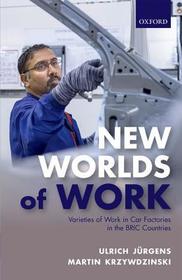
New Worlds of Work
Varieties of Work in Car Factories in the BRIC Countries
- Publisher's listprice GBP 99.00
-
47 297 Ft (45 045 Ft + 5% VAT)
The price is estimated because at the time of ordering we do not know what conversion rates will apply to HUF / product currency when the book arrives. In case HUF is weaker, the price increases slightly, in case HUF is stronger, the price goes lower slightly.
- Discount 10% (cc. 4 730 Ft off)
- Discounted price 42 568 Ft (40 541 Ft + 5% VAT)
Subcribe now and take benefit of a favourable price.
Subscribe
47 297 Ft

Availability
printed on demand
Why don't you give exact delivery time?
Delivery time is estimated on our previous experiences. We give estimations only, because we order from outside Hungary, and the delivery time mainly depends on how quickly the publisher supplies the book. Faster or slower deliveries both happen, but we do our best to supply as quickly as possible.
Product details:
- Publisher OUP Oxford
- Date of Publication 17 March 2016
- ISBN 9780198722670
- Binding Hardback
- No. of pages364 pages
- Size 240x162x25 mm
- Weight 670 g
- Language English 0
Categories
Short description:
This book provides a comparative study of human resource management, employment relations, and production systems in automobile factories in the BRIC countries (Brazil, Russia, India, and China). It compares the experiences of two major multinational companies, Volkswagen and Toyota, as well as of domestic automobile manufacturers.
MoreLong description:
New industrial centres are emerging in the so-called BRIC countries (Brazil, Russia, India, and China), where large numbers of plants have been constructed in recent years, creating many manufacturing jobs. But what does industrial work look like in these locations? Up until now, much of the interest in developing country industrialization has concentrated on the poor working conditions that characterize some export-oriented sectors in emerging economies, most notoriously in the garment industry. In contrast, the concern of this book is with the modern facilities of multinational or local manufacturers that reflect aspirations for a process of industrial upgrading that might foreshadow the future for these countries.
The book provides an analysis of work, its context, and the situation of employees in plants in the BRICs focussing on three main questions:
What differences and common features can be ascertained in a comparison both of countries and firms in terms of workplace HR management and production systems? What evidence is there for either a 'high road' or 'low road' developmental path in the BRICs? How are corporate standards implemented in these local contexts?
The book addresses an academic audience as well as managers and trade unionists. For the former, it offers a systematic comparison of the four countries and the companies under study. For the latter, it offers a vivid account of challenges the companies face in the BRIC countries as well as the solutions adopted by the companies.
Overall, this is a particularly useful book for teachers of comparative employment relations, especially given the scarcity of empirical investigations of ER in companies and plants from the BRIC countries. I will certainly use chapters from this book in the teaching of my comparative ER courses.

