

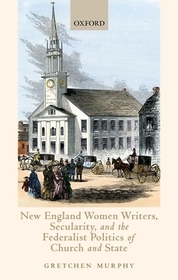
New England Women Writers, Secularity, and the Federalist Politics of Church and State
- Publisher's listprice GBP 92.00
-
41 538 Ft (39 560 Ft + 5% VAT)
The price is estimated because at the time of ordering we do not know what conversion rates will apply to HUF / product currency when the book arrives. In case HUF is weaker, the price increases slightly, in case HUF is stronger, the price goes lower slightly.
- Discount 10% (cc. 4 154 Ft off)
- Discounted price 37 384 Ft (35 604 Ft + 5% VAT)
Subcribe now and take benefit of a favourable price.
Subscribe
41 538 Ft

Availability
Estimated delivery time: In stock at the publisher, but not at Prospero's office. Delivery time approx. 3-5 weeks.
Not in stock at Prospero.
Why don't you give exact delivery time?
Delivery time is estimated on our previous experiences. We give estimations only, because we order from outside Hungary, and the delivery time mainly depends on how quickly the publisher supplies the book. Faster or slower deliveries both happen, but we do our best to supply as quickly as possible.
Product details:
- Publisher OUP Oxford
- Date of Publication 10 February 2021
- ISBN 9780198864950
- Binding Hardback
- No. of pages240 pages
- Size 222x145x21 mm
- Weight 430 g
- Language English 61
Categories
Short description:
Scholars have long known that early American women wrote pious, sentimental stories. This book uses biographical and archival sources to understand how their religious concerns fed into debates about democracy and belief in a republic, and offers a new account of their political participation and the process of religious disestablishment.
MoreLong description:
Drawing on literature, correspondence, sermons, legal writing, and newspaper publishing, this book offers a new account women's political participation and the process of religious disestablishment. Scholars have long known that eighteenth- and nineteenth-century American women wrote pious, sentimental stories, but this book uses biographical and archival methods to understand their religious concerns as entry points into the era's debates about democratic conditions of possibility and the role of religion in a republic. Beginning with the early republic's constitutional and electoral contests about the end of religious establishment and extending through the nineteenth century, Murphy argues that Federalist women and Federalist daughters of the next generation adapted that party's ideas and fears by promoting privatized Christianity with public purpose. Harriet Beecher Stowe, Catharine Sedgwick, Lydia Sigourney, Judith Sargent Murray, and Sally Sayward Wood authorised themselves as Federalism's literary curators, and in doing so they imagined new configurations of religion and revolution, faith and rationality, public and private. They did so using literary form, writing in gothic, sentimental, and regionalist genres to update the Federalist concatenation of religion, morality, and government in response to changing conditions of secularity and religious privatization in the new republic. Murphy shows that their project both complicates received narratives of separation of church and state and illuminates the problem of democracy and belief in postsecular America.
New England Women Writers, Secularity, and the Federalist Politics of Church and State is a genuinely significant contribution to the study of women writers, early debates over religion and secularity, and the enduring nature of a supposedly dead political tradition. Moreover, it spotlights several underappreciated texts worthy of further study and highlights an era of literary history that is often squeezed into obscurity between the turbulent 1790s and the "American Renaissance." Murphy should thus be heartily applauded for digging deep into what is often mischaracterized as a shallow period of literary history.
Table of Contents:
Introduction
Universalists and Jacobins in Judith Sargent Murray's The Gleaner
The Wonder of Rational Christianity: The Illuminati and Sally Sayward Wood
Lydia Sigourney in the Land of Steady Habits
Suspending Unbelief: The Secular Threats of Catharine Sedgwick's Redwood
Harriet Beecher Stowe's Evangelical Story of Disestablishment
Conclusion

