

- Publisher's listprice GBP 9.99
-
4 510 Ft (4 295 Ft + 5% VAT)
The price is estimated because at the time of ordering we do not know what conversion rates will apply to HUF / product currency when the book arrives. In case HUF is weaker, the price increases slightly, in case HUF is stronger, the price goes lower slightly.
- Discount 10% (cc. 451 Ft off)
- Discounted price 4 059 Ft (3 866 Ft + 5% VAT)
Subcribe now and take benefit of a favourable price.
Subscribe
4 510 Ft

Availability
Estimated delivery time: In stock at the publisher, but not at Prospero's office. Delivery time approx. 3-5 weeks.
Not in stock at Prospero.
Why don't you give exact delivery time?
Delivery time is estimated on our previous experiences. We give estimations only, because we order from outside Hungary, and the delivery time mainly depends on how quickly the publisher supplies the book. Faster or slower deliveries both happen, but we do our best to supply as quickly as possible.
Product details:
- Publisher OUP Oxford
- Date of Publication 26 March 2026
- ISBN 9780198876519
- Binding Paperback
- No. of pages144 pages
- Size 175x110x8 mm
- Weight 122 g
- Language English 1105
Categories
Short description:
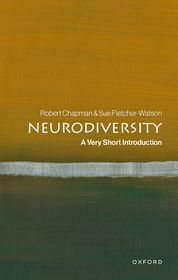
This book provides readers with a clear definition of neurodiversity, and an articulation of a neurodiversity-informed worldview. The book is positioned at the intersection of philosophy and psychology, with relevance spanning sociology, political theory, medicine, and biology.
MoreLong description:
Very Short Introductions: Brilliant, Sharp, Inspiring
Neurodiversity is the idea that human brains function in a variety of ways. By understanding that people take in, process, and respond to information differently, we can appreciate how these profound differences affect the ways in which we experience the world and form relationships with one another. In spite of the central simplicity of this concept, the consequences of fully understanding and exploring neurodiversity can be transformative.
This Very Short Introduction looks at how neurodiversity has been understood in a variety of settings including education, research, workplace, health and social care, and criminal justice. Robert Chapman and Sue Fletcher-Watson also draw out interesting connections to models of disability, human rights, anti-capitalism, and intersectionality. Alongside this, they discuss how issues of gender, sexuality, neuroqueering, and decoloniality bear on neurodiversity. The book is an engaging read for students, thinkers, and practitioners interested in neurodiversity and its links to philosophy, psychology, sociology, political theory, medicine, and biology.
ABOUT THE SERIES: The Very Short Introductions series from Oxford University Press contains hundreds of titles in almost every subject area. These pocket-sized books are the perfect way to get ahead in a new subject quickly. Our expert authors combine facts, analysis, perspective, new ideas, and enthusiasm to make interesting and challenging topics highly readable.
Table of Contents:
Preface
Introducing Neurodiversity
Neurodiversity as Democratic Theory and Research
Applications of the Neurodiversity Paradigm
Neurodiversity and Collective Liberation
Current Debates

