

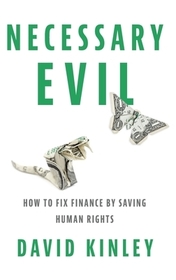
Necessary Evil
How to Fix Finance by Saving Human Rights
- Publisher's listprice GBP 24.49
-
11 057 Ft (10 530 Ft + 5% VAT)
The price is estimated because at the time of ordering we do not know what conversion rates will apply to HUF / product currency when the book arrives. In case HUF is weaker, the price increases slightly, in case HUF is stronger, the price goes lower slightly.
- Discount 10% (cc. 1 106 Ft off)
- Discounted price 9 951 Ft (9 477 Ft + 5% VAT)
Subcribe now and take benefit of a favourable price.
Subscribe
11 057 Ft

Availability
printed on demand
Why don't you give exact delivery time?
Delivery time is estimated on our previous experiences. We give estimations only, because we order from outside Hungary, and the delivery time mainly depends on how quickly the publisher supplies the book. Faster or slower deliveries both happen, but we do our best to supply as quickly as possible.
Product details:
- Publisher OUP USA
- Date of Publication 24 May 2018
- ISBN 9780190691127
- Binding Hardback
- No. of pages288 pages
- Size 160x239x27 mm
- Weight 499 g
- Language English 0
Categories
Short description:
Necessary Evil is a penetrating investigation into how the financial system both advances and undermines progress in human rights. It will be an indispensible read for anyone interested in how global finance can be reformed in ways that will salvage its legitimacy and fulfill its role as a human rights provider, not a vandal.
MoreLong description:
Finance is the evil we cannot live without. It governs almost every aspect of our lives and has the power to liberate as well as enslave. With the worldâs total financial assetsâvalued at a staggering $300 trillionâbeing four times larger than the combined output of all the worldâs economies, there is, apparently, plenty to go around. Yet, while proponents of finance-driven capitalism point to the trickle-down effect as its contribution to wealth redistribution, there are still nearly a billion people across the globe existing on less than $2 a day; 14 percent of Americans are living below the official poverty line; and disparities in wealth equality everywhere have reached unprecedented levels. Evidently a trickle is not enough.
How can this be when so much wealth abounds, and when finance is supposedly chastened and reformed after its latest global crisis? How, especially, can it be in an age when human rights are more loudly proclaimed than ever before? Can the financial sector be made to shoulder more of the burden of spreading wealth, reducing poverty, and protecting rights? And if so, what role can human rights play in making it happen?
In answering these questions, David Kinley draws on a vast array of material from bankers, economists, lawyers, and politicians, as well as human rights activists, philosophers, historians and anthropologists, alongside his own experiences working in the field. Necessary Evil shows how finance can shed its conceit, return to its role as the economyâs servant not its master, and regain the public trust and credibility it has so spectacularly lost over the past decadeâall by helping human rights, not harming them.
This book is a significant step towards bridging the chasm between finance and human rights. It outlines the myriad ways in which the realization of civil, political and socioeconomic rights is dependent on the financial resources-or indeed financial security-of both individuals and states.
Table of Contents:
Introduction
Taming the money monster
The argument
The research journey
The finance/human rights relationship
Stages in the relationship
Chapter 1 Strange bedfellows
Hubris
Finance as a utility
Financial ownership
Financial weapons of mass destruction
Transformative powers
Interdependency
The poverty prism
The public problem of private poverty
Incentives and exceptionalism
Anthropology on Wall Street
Mission statement
Chapter 2 Living together
Ends and means
Money as an instrument
A common liberal heritage
Human rights globalization
Paying for rights
Finding rights
Human rights and the global economy
Rights Politics
Complicated confederacy
Speaking different languages
Missed opportunities
Human needs and human rights
Rights differences
Rights impacts
Chapter 3 Flirting with Risk
The attraction
From boring banking to fantasy finance
The majesty and tragedy of leverage
Human rights risks
Rich world austerity
Poor world impacts
Faith
Faith no more
Greed
Greed in finance
When risk goes bad
Risky lessons
Conclusion
Chapter 4 Private matters
What money can buy
The generation and investment of wealth
Income
Remittances and credit
Rent-seeking
Capital
Capital and tyranny
Capital gains
Responsible capital
The business of impact
Equity and inequality
Rewarding capital
Consequences of unequal wealth
Wealth and giving
The givers
The Receivers
Mixed motivations
How much is enough?
The private/public connection
Chapter 5 Public affairs
Duty
The voice of human rights
Public funding of human rights
Taxation, representation and rights
The consequences of levying tax - a brief history
Of ghosts and icebergs - the consequences of lost tax
Tax as a force for good
Aid and debt
Development and human rights: more awkward than intimate
Partnering with the private sector
Getting the mix right
Does 'new' aid work?
Poorly
Promising
Possibly
Conclusion
Chapter 6 Cheating
Consequences
Deceit and subversion
Illicit finance
Tax evasion
Tax free
Tax sport
Misappropriation
Questions of impunity
Regulatory capture
Legal smoke screens
Denial in finance
Denial in human rights
Wishful thinking
Measuring progress
Conclusion
Chapter 7 Counseling and reconciliation
What sort of counsel?
The long shadow of financial exceptionalism
Attitudes and culture
Empathy
Responsibilities
Esteem
Sleaze
Capacity for change
Regulatory intervention and risk
Identification of risk
Allocation of risk
Risk and the rule of law
Alternatives
Reaching across the divide
Conclusion

