

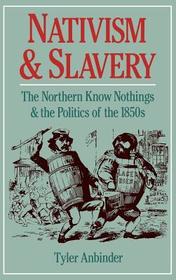
Nativism and Slavery
The Northern Know Nothings, and the Politics of the 1850s
- Publisher's listprice GBP 215.00
-
97 072 Ft (92 450 Ft + 5% VAT)
The price is estimated because at the time of ordering we do not know what conversion rates will apply to HUF / product currency when the book arrives. In case HUF is weaker, the price increases slightly, in case HUF is stronger, the price goes lower slightly.
- Discount 10% (cc. 9 707 Ft off)
- Discounted price 87 365 Ft (83 205 Ft + 5% VAT)
Subcribe now and take benefit of a favourable price.
Subscribe
97 072 Ft

Availability
printed on demand
Why don't you give exact delivery time?
Delivery time is estimated on our previous experiences. We give estimations only, because we order from outside Hungary, and the delivery time mainly depends on how quickly the publisher supplies the book. Faster or slower deliveries both happen, but we do our best to supply as quickly as possible.
Product details:
- Publisher OUP USA
- Date of Publication 18 February 1993
- ISBN 9780195072334
- Binding Hardback
- No. of pages352 pages
- Size 242x161x27 mm
- Weight 767 g
- Language English
- Illustrations halftones, maps, tables 0
Categories
Short description:
Tyler Anbinder has written the first comprehensive history of the Know-Nothings, and his book represents a major revision of historiography in the years leading up to the Civil War.
Political protest against immigrants has come to a head several times in American history. The most famous and influential such protest was exemplified by the Know-Nothing Party, founded in 1854 and directed especially against Catholic immigrants. By the end of 1855 the party had elected eight governors, over one hundred Congressmen, and thousands of local officials.
Long description:
Political protest against immigrants has come to a head several times in American history. The most famous and influential such protest was exemplified by the Know-Nothing Party, founded in 1854 and directed especially against Catholic immigrants. By the end of 1855 the party had elected eight governors, over one hundred Congressmen, and thousands of local officials. Prominent politicians of every persuasion joined the party, which then changed its name to the American Party. It became a major element in the new Republican Party, which first produced a presidential candidate in 1856. The party and its influence has not attracted much attention from historians, because the events involved in the coming of the Civil War eclipsed interest in a movement that was only peripherally involved with Civil War issues.
The Know-Nothings had a precipitous decline, starting with the 1856 election, at which their presidential candidate Millard Fillmore carried only one state. The Republican Party soon eclipsed it, too. Tyler Anbinder has written the first comprehensive history of the Know-Nothings, and his book represents a major revision of historiography in the years leading up to the Civil War.
James McPherson of Princeton comments: "The book ... adds an important dimension to the historiographical debate over the relationship between nativism, slavery, the breakdown of the second party system, and the origins of the Republican Party ... Anbinder convincingly puts the slavery issue back into its central role in breaking down the second party system."

