

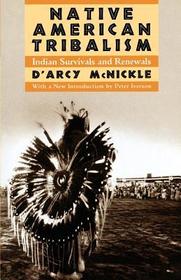
Native American Tribalism
Indian Survivals and Renewals
- Publisher's listprice GBP 13.49
-
6 090 Ft (5 800 Ft + 5% VAT)
The price is estimated because at the time of ordering we do not know what conversion rates will apply to HUF / product currency when the book arrives. In case HUF is weaker, the price increases slightly, in case HUF is stronger, the price goes lower slightly.
- Discount 10% (cc. 609 Ft off)
- Discounted price 5 481 Ft (5 220 Ft + 5% VAT)
Subcribe now and take benefit of a favourable price.
Subscribe
6 090 Ft

Availability
printed on demand
Why don't you give exact delivery time?
Delivery time is estimated on our previous experiences. We give estimations only, because we order from outside Hungary, and the delivery time mainly depends on how quickly the publisher supplies the book. Faster or slower deliveries both happen, but we do our best to supply as quickly as possible.
Product details:
- Publisher OUP USA
- Date of Publication 25 November 1993
- ISBN 9780195084221
- Binding Paperback
- No. of pages208 pages
- Size 215x141x14 mm
- Weight 308 g
- Language English
- Illustrations halftones, maps 0
Categories
Long description:
This is a reissue of Native American Tribalism with a new Introduction by Peter Iverson. In this book the late D'Arcy McNickle, Professor of Anthropology at the University of Saskatchewan, member of the Flathead Tribe of Montana, and founding member of the National Congress of American Indians reviews the history of almost four hundred years of contact between North American Indians and the dominant - and often domineering - Western civilization. McNickle shows that contrary to the white man's early expectations, the Indians of North America have maintained their cultural identity, social organization, size, locations of their population, and unique position before the law. He points out that even while stigmatized with the generalization of being an inferior race, harsh treatment by the white North American cultures, and severe obstacles such as epidemics of small pox, Indians have managed to remain an ethnic cultural enclave within American and Canadian society from colonial times through the present. McNickle maintains that Indians are eager to adopt knowledge and technology from the white society, but they want to fit these changes into their own culture. He argues that by emphasizing tribal self-determination, the federal government can best help Indians to modernize and achieve independence while maintaining their ancient heritage.
Peter Iverson's Introduction discusses McNickle's contribution to Native American studies and provides an overview of recent events and scholarship in the field. He has also updated the appendix describing the geographical distribution of the principle tribes in the United States and Canada.

