

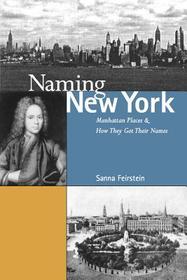
Naming New York
Manhattan Places and How They Got Their Names
- Publisher's listprice GBP 63.00
-
28 444 Ft (27 090 Ft + 5% VAT)
The price is estimated because at the time of ordering we do not know what conversion rates will apply to HUF / product currency when the book arrives. In case HUF is weaker, the price increases slightly, in case HUF is stronger, the price goes lower slightly.
- Discount 10% (cc. 2 844 Ft off)
- Discounted price 25 600 Ft (24 381 Ft + 5% VAT)
Subcribe now and take benefit of a favourable price.
Subscribe
28 444 Ft

Availability
printed on demand
Why don't you give exact delivery time?
Delivery time is estimated on our previous experiences. We give estimations only, because we order from outside Hungary, and the delivery time mainly depends on how quickly the publisher supplies the book. Faster or slower deliveries both happen, but we do our best to supply as quickly as possible.
Product details:
- Publisher New York University
- Date of Publication 1 April 2001
- Number of Volumes Print PDF
- ISBN 9780814727119
- Binding Hardback
- See also 9780814727126
- No. of pages207 pages
- Size 229x153 mm
- Weight 666 g
- Language English 0
Categories
Long description:
"
A comprehensive compilation and explanation of Manhattan's streets, alleys, avenues, plazas, parks and corners
New York is the oldest continually occupied city in America, yet its rich history is largely obscured by development. New Yorkers are surrounded by hundreds of place names, from those that survive from Manhattan's earliest days as a Dutch trading post to those that reflect the city's rich colonial, African and immigrant heritage. They provide a veritable encyclopedia of the city's history. Buildings may come and go, but place names are surprisingly durable. Naming New York is a comprehensive compilation and explanation of the names of Manhattan's streets, alleys, avenues, plazas, parks and corners. It surveys names currently in use and includes the oldest and the newest honorific ""add-on"" names, from Astor Place to Yitzak Rabin Way.
Whether you're a history or trivia buff, tourist, or just fascinated by place names, learning about the origins of these mostly unexamined sources enriches one's experience of the city, and transforms a simple neighborhood errand into a trip through time.
For example:
Bowery: In the 17th century, Dutch farms known as ""bowerij"" were laid out in this section of Manhattan along the path of an old Indian trail. Known since that time as the Bowery, the thoroughfare became the first section of the Post Road from New York City to Boston.
Houston Street: For William Houstoun, 1757-1812, of a prominent Georgia family, who married a daughter of Manhattan landowner Nicholas Bayard III. The Georgia provenance of the name accounts for its pronunciation and spelling both of which distinguish it from the Texas city.
Wall Street: Follows the line of the city wall that the Dutch erected in 1653 across the northern perimeter of New Amsterdam to protect against attack from the British in New England.

