

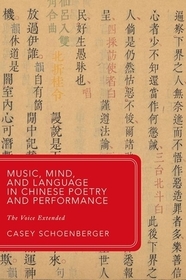
Music, Mind, and Language in Chinese Poetry and Performance
The Voice Extended
Series: Global Asias;
- Publisher's listprice GBP 84.00
-
40 131 Ft (38 220 Ft + 5% VAT)
The price is estimated because at the time of ordering we do not know what conversion rates will apply to HUF / product currency when the book arrives. In case HUF is weaker, the price increases slightly, in case HUF is stronger, the price goes lower slightly.
- Discount 10% (cc. 4 013 Ft off)
- Discounted price 36 118 Ft (34 398 Ft + 5% VAT)
Subcribe now and take benefit of a favourable price.
Subscribe
40 131 Ft

Availability
Estimated delivery time: Expected time of arrival: end of January 2026.
Not in stock at Prospero.
Why don't you give exact delivery time?
Delivery time is estimated on our previous experiences. We give estimations only, because we order from outside Hungary, and the delivery time mainly depends on how quickly the publisher supplies the book. Faster or slower deliveries both happen, but we do our best to supply as quickly as possible.
Product details:
- Publisher OUP Oxford
- Date of Publication 14 March 2024
- ISBN 9780198886211
- Binding Hardback
- No. of pages304 pages
- Size 240x160x22 mm
- Weight 616 g
- Language English
- Illustrations 17 black and white illustrations 545
Categories
Short description:
This innovative study introduces the rhythms, melodies, language, and organization of traditional Chinese poetry and vocal arts. Using insights from cognitive neuroscience, digital humanities, musicology, and linguistics, Casey Schoenberger offers new perspectives on a wide range of issues in the field.
MoreLong description:
"Poetry puts intent into words; singing lengthens words"--this is one of the earliest Chinese comments on artistic expression. Poetic language extends the reach of a sentiment beyond the individual, and musicality extends the reach of poetic language, not only across a room, but across geography and generations. The "extended mind thesis" (EMT) views minds as extending beyond individual nervous systems to include material and social environments.
Music, Mind, and Language in Chinese Poetry and Performance: The Voice Extended offers a comprehensive overview of the interwoven histories of traditional Chinese poetry and performing arts. It employs cognitive and quantitative methods such as EMT, and a database of over six thousand traditional melodies, to describe cyclical, continuous interactions between social minds and material artifacts.
From the ancient Canon of Poetry to the song-lyrics (ci) of the late medieval period and the dramatic arias of Kun and Beijing operas, Casey Schoenberger introduces the rhythms, melodies, pronunciation, and grammatical stylistics of the major Chinese verse and performance traditions. In doing so, he gleans insights from cognitive neuroscience, digital humanities, musicology, and linguistics to explain not only the trajectory of Chinese arts, but also bigger phenomena, like vernacularisation and improvisation.
Table of Contents:
Acknowledgments
List of Illustrations
Chinese Dynastic Periods
Note on Conventions
Introduction: Creative Cycles of the Extended Mind
The Death of Rhythm
The Birth of Melody
Languages without Native Speakers
Music without Composers
Coda: Lively Rhythms of Equal Lines, Ever-Present Past
Glossary and Abbreviations
Works Cited
Index

