

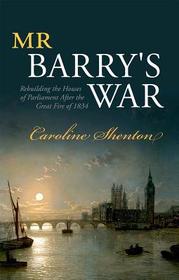
Mr Barry's War
Rebuilding the Houses of Parliament after the Great Fire of 1834
- Publisher's listprice GBP 29.99
-
13 540 Ft (12 895 Ft + 5% VAT)
The price is estimated because at the time of ordering we do not know what conversion rates will apply to HUF / product currency when the book arrives. In case HUF is weaker, the price increases slightly, in case HUF is stronger, the price goes lower slightly.
- Discount 10% (cc. 1 354 Ft off)
- Discounted price 12 186 Ft (11 606 Ft + 5% VAT)
Subcribe now and take benefit of a favourable price.
Subscribe
13 540 Ft

Availability
Estimated delivery time: In stock at the publisher, but not at Prospero's office. Delivery time approx. 3-5 weeks.
Not in stock at Prospero.
Why don't you give exact delivery time?
Delivery time is estimated on our previous experiences. We give estimations only, because we order from outside Hungary, and the delivery time mainly depends on how quickly the publisher supplies the book. Faster or slower deliveries both happen, but we do our best to supply as quickly as possible.
Product details:
- Publisher OUP Oxford
- Date of Publication 8 September 2016
- ISBN 9780198707196
- Binding Hardback
- No. of pages310 pages
- Size 236x168x29 mm
- Weight 548 g
- Language English
- Illustrations 42 black & white illustrations, 8pp colour plate section 0
Categories
Short description:
The saga of the epic battle to re-build the Houses of Parliament after the great fire of 1834, this is also the story of how the greatest construction programme in Britain for centuries produced one of the most famous and instantly recognizable buildings ever built
MoreLong description:
When the brilliant classical architect Charles Barry won the competition to build a new, Gothic, Houses of Parliament in London he thought it was the chance of a lifetime. It swiftly turned into the most nightmarish building programme of the century. From the beginning, its design, construction and decoration were a battlefield. The practical and political forces ranged against him were immense.
The new Palace of Westminster had to be built on acres of unstable quicksand, while the Lords and Commons carried on their work as usual. Its river frontage, a quarter of a mile long, needed to be constructed in the treacherous currents of the Thames. Its towers were so gigantic they required feats of civil engineering and building technology never used before. And the interior demanded spectacular new Gothic features not seen since the middle ages.
Rallying the genius of his collaborator Pugin; flanking the mad schemes of a host of crackpot inventors, ignorant busybodies and hostile politicians; attacking strikes, sewage and cholera; charging forward three times over budget and massively behind schedule, it took twenty-five years for Barry to achieve victory with his 'Great Work' in the face of overwhelming odds, and at great personal cost.
Mr Barry's War takes up where its prize-winning prequel The Day Parliament Burned Down left off, telling the story of how the greatest building programme in Britain for centuries produced the world's most famous secular cathedral to democracy.
A very worthwhile addition to the bookshelves of aficionados of Victorian design and architecture.
Table of Contents:
Prologue
FIRE (1834-1837)
A New Tooth
A Clump of Thistles
A Beautiful and Appropriate Design
WATER (1837-1843)
A Clear Understanding
A Bondage Worse than the Egyptians
A Very Heavy Expence
AIR (1844-1852)
A Regular Fix
A Very Difficult Work
A Metropolitan Asylum
EARTH (1852-1860)
A Monstrous Failure
A More Cunning and Intriguing Man
The Great Work
Epilogue
Select Bibliography
Index

